Jazz Guitar Lessons
Learning to Improvise in Jazz: Listen, Analyze the Song and Practice Slowly
Learning to improvise in jazz starts long before you play a solo. You listen to a lot of jazz — from Louis Armstrong and the swing bands of the 1930s to bebop in the 1940s and the classic albums of the 1950s — including singers performing the standards. Then you learn a song, analyze its chords to find the key and the ii–V–I’s, and practice slowly, one section at a time, starting with the first eight bars.
Improvisation is a language, and languages are learned by ear
Every jazz teacher gives the same first piece of advice: listen. A child learns to speak by hearing thousands of hours of conversation before saying a word, and only later learns grammar. Jazz works the same way. The rhythm of swing, the shape of a phrase, the way a line lands on a chord — none of this can be learned from a book alone. Books give you the grammar; records give you the accent.
So before we talk about chords and scales, here is your listening plan. Put on these records while you cook, drive or rest. Then, a few times a week, listen actively: one track, one solo, full attention.
Start with Louis Armstrong
Louis Armstrong is where jazz improvisation as we know it begins. His recordings with the Hot Five and Hot Seven (1925–1928) showed the world that a soloist could tell a story over a chord progression; “West End Blues” (1928) opens with one of the most famous solo cadenzas in jazz. Listen to his trumpet and to his voice: Armstrong sang the way he played, bending the melody, delaying it, swinging every syllable.
Then listen to Ella and Louis (1956), where he sings standards with Ella Fitzgerald. You will hear two of the greatest jazz musicians take a familiar song and make it theirs without ever losing the melody. That is exactly what you want to learn to do on the guitar.
A listening plan by decade: the 1930s, 1940s and 1950s
The 1930s: swing
- Duke Ellington and Count Basie orchestras — listen to the soloists and to the rhythm section; in Basie’s band, notice Freddie Green’s four-to-the-bar guitar.
- Coleman Hawkins, “Body and Soul” (1939) — a tenor saxophone solo that is a lesson in playing the changes.
- Billie Holiday with Lester Young — how a singer and a saxophonist phrase behind and around the beat.
- Benny Goodman Sextet with Charlie Christian (1939–1941) — the birth of the electric jazz guitar.
- Django Reinhardt and Stéphane Grappelli — the Quintette du Hot Club de France and the sound of European swing.
The 1940s: bebop and the great singers
- Charlie Parker and Dizzy Gillespie — bebop: faster tempos, richer harmony, long eighth-note lines.
- The Nat King Cole Trio — piano, bass and the guitar of Oscar Moore; a model of trio swing and of a singer who was also a great pianist.
- Ella Fitzgerald and Sarah Vaughan — two voices that every instrumentalist should study for phrasing and pitch.
The 1950s: the classic albums
- Miles Davis, Kind of Blue (1959) — space, melody and modal improvisation.
- Sonny Rollins, Saxophone Colossus (1956) — thematic improvisation: building a solo from the melody.
- Clifford Brown and Max Roach — clear, singing bebop lines.
- Chet Baker, Chet Baker Sings (1954) — a trumpeter who sings standards with almost no vibrato.
- Frank Sinatra, In the Wee Small Hours (1955), and Ella Fitzgerald, Ella Fitzgerald Sings the Cole Porter Song Book (1956) — the standards sung the way their composers imagined them.
- Guitarists: Kenny Burrell, Barney Kessel, Herb Ellis and, at the turn of the decade, Wes Montgomery.
Why you should listen to singers
Most of the tunes jazz musicians play — the standards — are songs from the Great American Songbook: popular songs from Broadway shows and Hollywood films of the 1920s to the 1950s, by composers such as George Gershwin, Cole Porter, Irving Berlin, Jerome Kern and Harold Arlen. They were written to be sung.
Listening to singers teaches you three things that instrumental versions often hide: the melody in its simplest form, the phrasing (where the lines breathe, which is where the lyrics breathe) and the meaning of the song. A ballad about loss and an up-tempo swing tune ask for different solos. Many great instrumentalists learned the lyrics of every standard they played for exactly this reason.
Learn the song before you improvise on it
Pick one standard. Listen to three or four versions — at least one by a singer and one by an instrumentalist. Then learn it in this order:
- Sing the melody until you know it by heart.
- Play the melody on the guitar in one position, then in a second position.
- Learn the form: how many sections, how many bars each, which ones repeat. Our guide to jazz song forms (AABA, ABAC, AAB, blues) explains how.
- Play the chords slowly, with simple voicings, while you hum the melody.
Analyze the chords: find the key and the ii–V–I’s
Once you know the song, look at its chord chart as a map. Two questions unlock almost every standard:
- What is the key? The key signature, the last chord and the way the chords resolve tell you. See how to tell what key a jazz song is in.
- Where are the ii–V–I’s? Most standards are chains of ii–V–I progressions, some in the home key and some in other keys for a few bars. Mark each one with a bracket. Eight chords become two or three ideas.
Our step-by-step guide how to analyze a jazz standard for improvisation shows the whole method, and three complete analyses put it into practice: Autumn Leaves, All of Me and There Will Never Be Another You.
Practice slowly, one section at a time
Here is where most students go wrong: they try to improvise over the whole tune at full tempo from the first day. Instead, start with the first section only — usually the first eight bars, the first A section.
- Set the metronome to 60, clicking on beats two and four.
- Play the root of each chord in half notes through the eight bars.
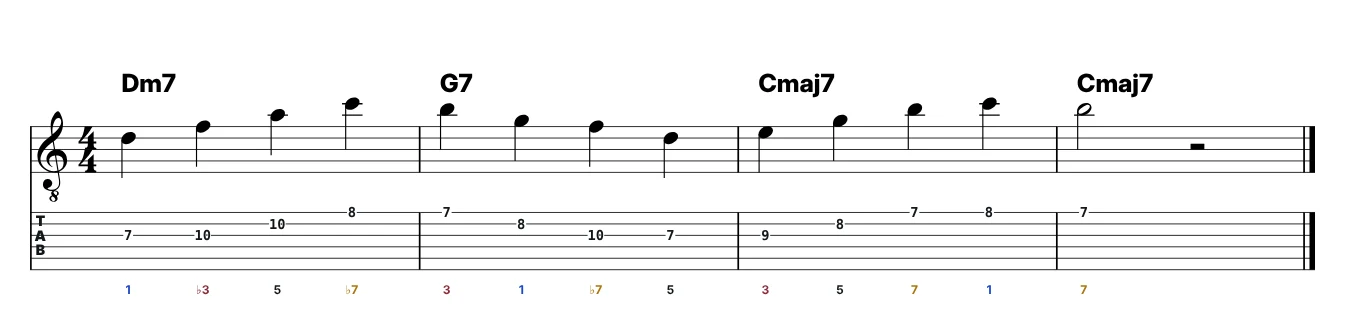
- Play the guide tones (3rd and 7th) of each chord.
- Play the arpeggios in quarter notes, in one position.
- Improvise two-bar phrases with two bars of rest in between.
- Only when the first section feels easy, add the next section, then the whole form.
- Raise the tempo by 5–10 beats per minute at a time.
A weekly routine for learning to improvise
| Day | Listening (15 min) | Playing (20–30 min) |
|---|---|---|
| 1 | Three versions of the new standard, one sung | Sing and play the melody |
| 2 | One solo from the 1930s or 1940s | Learn the form and the chords |
| 3 | A singer from the list | Analyze: key and ii–V–I’s |
| 4 | One solo from the 1950s | First section: roots, guide tones, arpeggios at 60 |
| 5 | Your favorite guitarist | First section: two-bar phrases |
| 6 | Free listening | Add the next section |
| 7 | Rest, or listen for fun | Record one chorus and listen back |
When you are ready to work on the notes themselves, continue with how to improvise on jazz guitar and how to improvise over chord changes.
Frequently asked questions
What should I listen to first to learn jazz improvisation?
Start with Louis Armstrong (the Hot Five and Hot Seven, and Ella and Louis), then swing from the 1930s, bebop from the 1940s and classic albums from the 1950s such as Kind of Blue and Saxophone Colossus, plus singers such as Billie Holiday, Ella Fitzgerald and Frank Sinatra.
Why should jazz guitarists listen to singers?
Because most standards are songs. Singers show you the melody, the phrasing and the meaning of the song, which helps you build solos that sound like music rather than exercises.
How slowly should I practice improvising?
Start around 60 beats per minute with the metronome on beats two and four, and raise the tempo by 5 to 10 beats only when the section feels easy.
Should I learn the whole tune at once?
No. Learn the melody of the whole song, but practice improvising on the first section first. Add the next section only when the first one feels comfortable.