Jazz Guitar Lessons
History of Jazz Guitar: From Its Beginnings to Today, for Beginners
Jazz guitar began as a rhythm instrument in New Orleans bands. Eddie Lang made it a jazz voice in the 1920s, Django Reinhardt gave it a European and gypsy jazz identity, and Charlie Christian made the electric guitar a solo instrument with the Benny Goodman Sextet. Wes Montgomery, Jim Hall, Kenny Burrell, Joe Pass and Pat Martino then expanded its language, and fusion and today’s players carried it further. This guide tells the story in order, with the records to hear at each step.
Before the guitar had a solo voice
The guitar entered jazz as a timekeeper, not as a soloist. In New Orleans in the first decades of the twentieth century, bands marched and played dance music with a rhythm section built from banjo, guitar, bass, drums and piano. The guitar strummed chords on every beat or every other beat, so the band had a steady pulse and the harmony was clear. Nobody expected it to play a melody on its own.
That role changed slowly. When Louis Armstrong recorded with the Hot Five and Hot Seven between 1925 and 1928, the rhythm sections were small, and the banjo and guitar of Johnny St. Cyr kept the groove steady under the trumpet and the clarinet. The recordings show what the guitar was for at that time: it made the music swing, and the front line did the talking.
Two things made the change possible. The first was the amplifier and the electric pickup, which let a guitar be heard over a horn section. The second was the arrival of musicians who had the technical skill to play single notes and lines with the same confidence a saxophonist or trumpeter had. For the guitar to lead a jazz band, both of those had to happen.
Eddie Lang and the first recorded guitar voices
The first guitarist to be heard as a jazz musician, not only as a rhythm player, was Eddie Lang. Working in New York in the late 1920s, he recorded many sessions with the cornetist Bix Beiderbecke and the violinist Joe Venuti, and his single-note lines were precise and light. Lang showed that an acoustic guitar could answer a horn phrase, trade ideas with a soloist and still keep the chords clear underneath. He died in 1933, young, after surgery, and his early death is one reason he is less famous than he should be.
In the same years, Lonnie Johnson, a blues guitarist with a sophisticated sense of harmony, recorded with many of the best jazz players of the period. His work showed that the blues and the swing of jazz could share the same instrument, an idea that every later guitarist inherited.
Django Reinhardt and the European voice
Django Reinhardt is the most important name in the early history of jazz guitar. Born in Belgium in 1910 into a Romani family, he grew up playing banjo and then guitar in the camps and cafés of Paris. In 1928 a fire in his caravan badly burned his left hand. He lost much of the use of two fingers, and he had to invent a new way of fingering chords and lines with the remaining fingers. The result was a style that sounds unlike any other, fast and dense, with a singing lead tone and an astonishing sense of swing.
In 1934 he founded the Quintette du Hot Club de France with the violinist Stéphane Grappelli. The group was made of string instruments only, with no drums and no horns, and it recorded and toured across Europe and England. Its records, including the famous “Minor Swing” and later “Nuages”, became the basis of gypsy jazz, a tradition that still has a large following. Reinhardt’s pieces show how the guitar could carry a full jazz band in its own right, long before the electric instrument took over the role.
Charlie Christian makes the electric guitar a solo voice
The guitar became a front-line instrument in America through Charlie Christian. Born in Texas in 1916, he played with the Benny Goodman Sextet from 1939 to 1941, and he was the first musician to use an electric guitar as a solo voice in a major jazz group. His ideas were simple to hear and hard to copy: long, flowing eighth-note lines, a strong sense of the blues, and phrases that moved from chord to chord with the logic of a horn player.
Christian’s recordings with Goodman, including “Solo Flight”, were heard across the country and sent a message to every young guitarist: the instrument could improvise at the level of the best saxophonists. He also played informal sessions at Minton’s Playhouse in New York, where the new music later called bebop was taking shape. He died of tuberculosis in 1942, at only twenty-five. In a career of about three years on record, he changed what the instrument was expected to do.
Bebop and the guitar’s uncertain place
Bebop, which grew from those sessions in the early 1940s, was built around trumpet and alto saxophone lines, fast tempos and harmonies that moved quickly. The guitar, which was still often used for chords, was not always well suited to these fast harmonic changes, and many bebop groups did without it. Some of the best guitarists of the period found work in other styles and in big bands. Freddie Green, for example, spent decades as the rhythm guitarist of the Count Basie band. His playing was so steady and so economical, with strummed chords on the off beats, that it became the core of the Basie sound.
Yet the bebop era also produced guitarists who learned the new harmonic language. Barney Kessel, Tal Farlow and Herb Ellis are the best known. Ellis, in particular, joined the Oscar Peterson Trio in the 1950s, and his recordings with Peterson and the bassist Ray Brown show a guitarist who could swing at high speed and still leave room for the piano.
Wes Montgomery and the octave sound
Wes Montgomery is the guitarist most often named by students who want to start with one player. Born in Indianapolis in 1923, he taught himself to play, and he used his thumb rather than a pick. This gave him a warm, round tone and let him play melody and chords at the same time. He often played melodies in octaves, two notes an octave apart, which made single lines sound full and rich.
His records for Riverside in the early 1960s brought him wide recognition. “The Incredible Jazz Guitar of Wes Montgomery” and the live album “Full House” show his swing, his blues feeling and his economy. He had a commercial period later in the decade, and then he died suddenly in 1968, at forty-five. His influence on guitarists who use octaves, block chords and the thumb is still very large.
Jim Hall, Kenny Burrell and the modern lyric
The generation that came after Montgomery was more varied. Jim Hall, who worked with Sonny Rollins and Bill Evans, was known for a quiet, conversational style. His duet album with Evans, “Undercurrent” (1962), is one of the most admired records in jazz guitar, and his later work with the arranger Gil Evans on “Concierto de Aranjuez” (1975) showed how far the instrument could go in a large orchestral setting.
Kenny Burrell, with his deep blues feeling and a clean, dark sound, made “Midnight Blue” (1963) for Blue Note, a record many students use as a model of a guitar-led quartet. Grant Green, with the album “Idle Moments” (1963), brought the soulful side of the instrument into the Blue Note catalogue. Together these players showed that the guitar could be lyrical, bluesy and sophisticated at the same time.
Their recordings also show a practical lesson that every student can use. Pass played chord melodies, which means a tune’s melody and harmony are played at the same time. Montgomery used octaves, which means two notes an octave apart. Reinhardt used a different fingering. Each player found a solution to the same problem: how to make one guitar sound complete. When you learn a standard, ask yourself which of these solutions fits your hands, your tone and the way you hear a song.
Joe Pass and Pat Martino
Joe Pass was a virtuoso who made solo guitar a complete jazz language. His series of records for the Pablo label in the 1970s, under the title “Virtuoso”, presented the instrument as a full ensemble: bass line, chords and melody played together by one player. Students who want to understand harmony at a high level often study his voicings and his way of moving through the changes.
Pat Martino, from Philadelphia, was among the most technically gifted players of his generation. In 1980 he suffered a brain aneurysm that left him without much of his memory of music. He had to relearn the guitar, and he came back to playing and recording. His story is often told as an example of discipline and rebuilding, and his earlier records remain essential listening.
The electric guitar in fusion and beyond
In the 1970s, jazz guitar moved toward rock, funk and new electronic sounds. John McLaughlin, with the Mahavishnu Orchestra and the album “Birds of Fire” (1973), used high volume, fast unison lines and a very high technique to reach a new audience. George Benson, with “Breezin’” (1976), brought the guitar to the pop charts. Pat Metheny, on his album “Bright Size Life” (1976), with the bassist Jaco Pastorius, showed a new kind of lyrical, melodic writing for the guitar and the electric sound.
These records were controversial among purists, but they widened the instrument’s reach. Many guitarists who started in rock or pop later moved to jazz because of them, and the mix of acoustic and electric approaches they encouraged is still common.
Jazz guitar today
Today the instrument is in a rich and varied state. Players such as Kurt Rosenwinkel, Mike Stern, Julian Lage, Peter Bernstein and Bill Frisell each take a different path, from harmonic experiment to folk-based lyricism. The gypsy jazz tradition of Django Reinhardt also remains active, with players such as Biréli Lagrène carrying it into new settings. Students today have access to more recordings, transcriptions and teaching material than any earlier generation, and that makes it possible to study the history directly from the records.
A short timeline of jazz guitar
- 1920s: the guitar keeps time in New Orleans and Chicago bands; Eddie Lang records as a jazz voice in New York.
- 1934: Django Reinhardt and Stéphane Grappelli found the Quintette du Hot Club de France in Paris.
- 1939–1941: Charlie Christian plays electric guitar solos with the Benny Goodman Sextet.
- 1940s: bebop reshapes harmony, and the guitar adapts with chord-melody and single-note lines.
- 1950s–1960s: Herb Ellis, Barney Kessel, Wes Montgomery, Kenny Burrell and Grant Green define the mainstream sound.
- 1970s: Joe Pass, John McLaughlin, George Benson and Pat Metheny expand the instrument into solo, fusion and pop.
- Today: players from many traditions, including gypsy jazz, keep the instrument growing with new recordings and teaching.
This timeline is simplified. Many players were active across several decades, and each step overlaps with the next. Use it as a map, then fill it in with the records.
Where to start if you know nothing about jazz guitar
The best way to begin is to listen, in order. Start with Eddie Lang and Django Reinhardt to hear where the instrument came from. Then listen to Charlie Christian with the Goodman Sextet, to hear the guitar as a horn. Next, Wes Montgomery and Kenny Burrell will show you a clear, swinging, blues-based sound that is close to what most students play. Jim Hall and Joe Pass come after that, when your ear is ready for harmony at a higher level.
While you listen, learn a few basic chords and follow a simple melody. Our guide to learning to improvise in jazz explains how to turn listening into practice, and the full list of the most influential jazz guitarists gives you a biography and a listening path for each one.
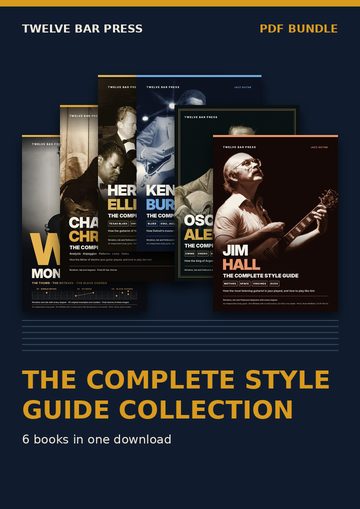
A good book helps as well. The Complete Style Guide Collection follows six of these players with examples in notation and TAB, so you can play their ideas as well as hear them.
Frequently asked questions
Who invented jazz guitar?
No single person did. The guitar was a rhythm instrument in early jazz bands in New Orleans. Eddie Lang was the first guitarist recorded as a jazz voice in the late 1920s, and Django Reinhardt and Charlie Christian are the two players who made the instrument a soloist.
Who was the first electric jazz guitarist?
Charlie Christian is generally credited with bringing the electric guitar into jazz as a solo voice, with the Benny Goodman Sextet from 1939 to 1941.
Which jazz guitarist should a beginner listen to first?
Start with Charlie Christian, Wes Montgomery and Kenny Burrell. Their lines are clear, swinging and close to the blues, which makes them a good model for a student.