Jazz Guitar Lessons
How to Learn Jazz Guitar in 2027: A Step-by-Step Roadmap
To learn jazz guitar, follow the order the great players used: listen to jazz records actively, learn shell and drop-2 chord voicings, master the ii–V–I and the jazz blues, learn which scale fits each chord, then improvise with chord tones, guide tones and enclosures over real standards. Thirty minutes of focused daily practice is enough to comp a blues and play your first lines within weeks.
Can you learn jazz guitar on your own?
Yes. Almost every great jazz guitarist learned mostly by listening to records and copying them, long before jazz was taught in schools. What you need is not talent or a teacher every week, but the right order: listen first, then learn a small set of chords and scales, then use them over real chord changes, a little every day.
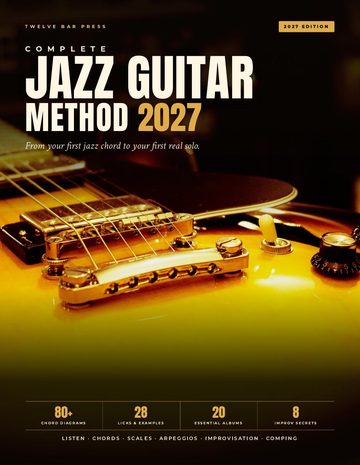
This roadmap follows that order. It is the same path we use in Complete Jazz Guitar Method 2027, and you can start it today with any guitar.
Step 1: Learn to listen like a jazz musician
Jazz is a language, and you learn a language by hearing it. Most small-group performances follow the same roadmap: an intro, the melody (the “head”), solos over the same chords, sometimes trades with the drums, the head again and an ending. One pass through the chords is a chorus. Our guide to jazz song forms explains AABA, ABAC and the 12-bar blues.
Then listen in layers. Follow only the walking bass for a chorus, then only the comping, then the soloist. Twenty minutes of active listening a day, without your phone, will change your playing faster than any scale book.
- Start with: Wes Montgomery, The Incredible Jazz Guitar of Wes Montgomery (1960).
- Then: Kenny Burrell, Midnight Blue (1963), and Grant Green, Idle Moments (recorded 1963).
- Beyond guitar: Miles Davis, Kind of Blue (1959), for space and melody.
Our list of the most influential jazz guitarists and the history of jazz guitar give you a full listening path.
Step 2: Learn the chords jazz guitarists actually use
Forget big six-string barre chords. Jazz guitarists play small voicings of three or four notes. Start with shell voicings: the root, the 3rd and the 7th. With root-on-the-sixth and root-on-the-fifth string shapes for maj7, 7 and m7 you can already play most standards.
Then add four-note seventh chords, drop-2 voicings on the top four strings (so any chord tone can be the melody), and extensions such as 9ths and 13ths. The 3rd and the 7th of each chord matter most: they define its quality and they move smoothly from chord to chord.
Step 3: Learn the progressions that make up the standards
| Progression | In C | Where you hear it |
|---|---|---|
| Major ii–V–I | Dm7 – G7 – Cmaj7 | in almost every standard |
| Minor ii–V–i | Dm7♭5 – G7♭9 – Cm6 | Autumn Leaves, Blue Bossa |
| Jazz blues | 12 bars with ii–Vs and a turnaround | jam sessions everywhere |
| Turnaround | Cmaj7 – A7 – Dm7 – G7 | the end of most sections |
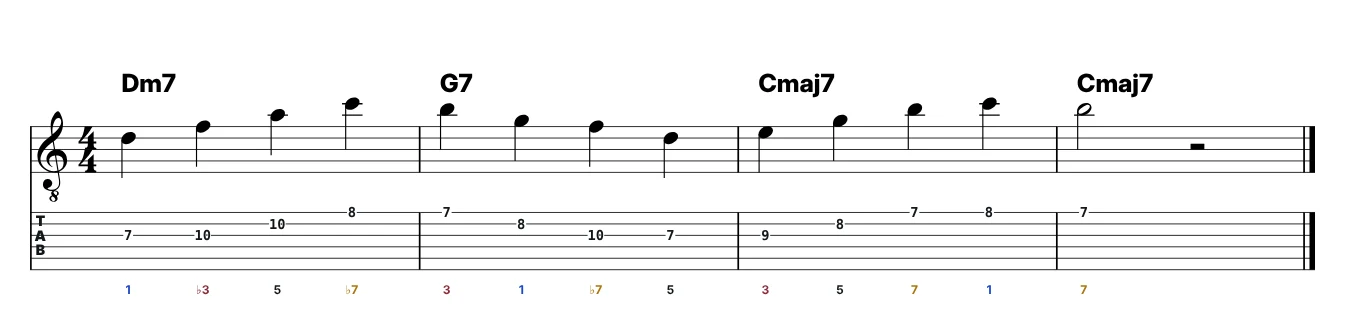
Learn the ii–V–I in all twelve keys, one key a day, with shell voicings. In two weeks the most common sound in jazz will live in your hands.
Step 4: Know which scale goes over which chord
You do not need fifty scales. You need about eight and a clear idea of where each one goes: major over maj7, Dorian over m7, Mixolydian over unaltered dominants, the altered or diminished scale over dominants that resolve, and the blues and pentatonic scales for colour. Our article on jazz guitar scales explains them one by one.
Step 5: Start improvising with eight simple tricks
- Chord tones on the beat: put the 1, 3, 5 or 7 of the chord on beats 1, 2, 3 and 4.
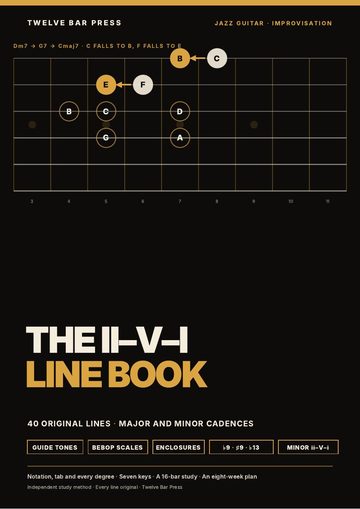
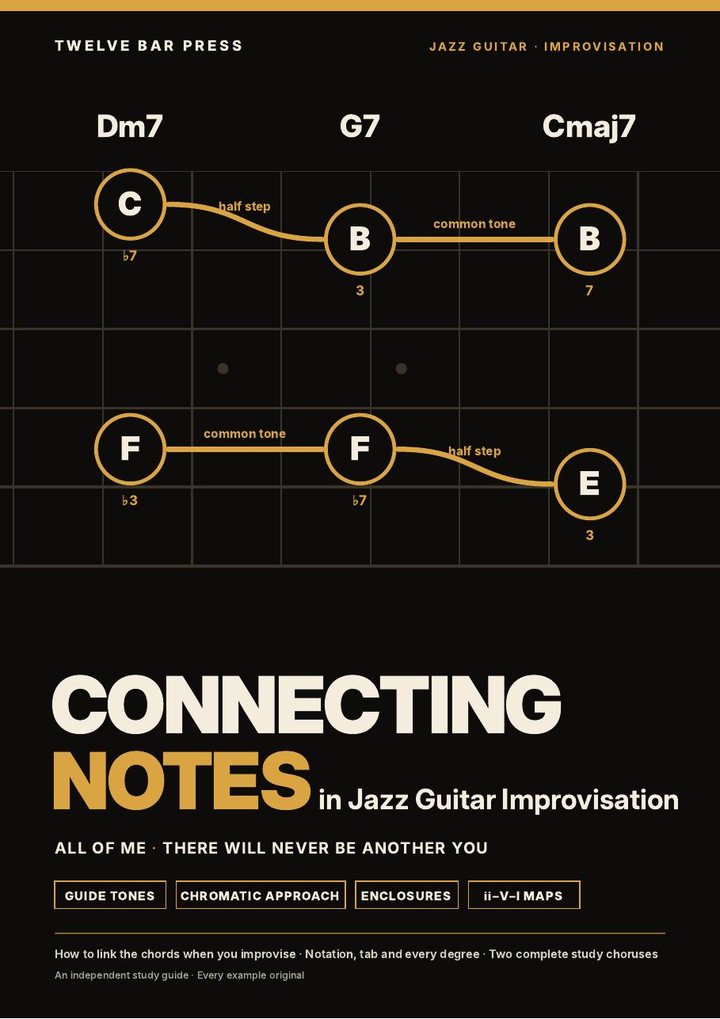
- Guide tones: follow the 3rds and 7ths through the changes.
- Approach notes and enclosures: reach a target note from a half step below, or from above and below.
- Motifs: repeat a short idea, move it, change its rhythm.
- Pentatonic superimposition: E minor pentatonic over Cmaj7 gives you 3, 5, 6, 7 and 9.
- Altered tension: ♭9, ♯9 and ♭13 on the V chord, then resolve.
- Space: call and response; let the phrase breathe.
- Rhythm: start phrases on off-beats, not always on beat 1.
If you want more detail, read how to improvise on jazz guitar and how to improvise over chord changes.
Step 6: Learn tunes, not just exercises
Repertoire is what you play with other musicians. Begin with standards that teach one thing each: Autumn Leaves for the major and minor ii–V–I, Blue Bossa for the minor key, a blues such as Straight, No Chaser, and a medium swing tune such as All of Me. Learn each melody by ear, then its bass notes, then comp it with shells and play one chorus of chord tones. Our list of jazz guitar standards gives you 120 tunes to choose from.
A 30-minute daily practice routine
| Minutes | What to practise |
|---|---|
| 5 | Listening: one track, one layer at a time |
| 7 | Chords and comping: shells and drop-2s through a ii–V–I or a blues |
| 6 | Scales and arpeggios: one scale and four arpeggios, swung |
| 7 | Lines and licks: one lick in two keys, then use it |
| 5 | Play-along: improvise over a backing track and record it |
Keep a practice log with the date, the tempo and what you played. Seeing 80 bpm turn into 140 bpm is the best motivation there is.
How long does it take to learn jazz guitar?
With 30 minutes a day, most players who already know open and barre chords can comp a jazz blues and play simple lines over a ii–V–I within four to six weeks, and work through a complete beginner-to-intermediate method in four to six months. Becoming fluent takes years, and that is the fun of it: the masters kept learning all their lives.
If you want the whole path in one book, with every example in notation, TAB and colour-coded degrees, Complete Jazz Guitar Method 2027 takes you from your first jazz chord to your first real solo.
Frequently asked questions
Can I learn jazz guitar without a teacher?
Yes. Most great jazz guitarists learned by listening to records and copying them. A clear method, daily listening and backing tracks are enough to start; lessons help later to correct details.
Do I need to read music to play jazz guitar?
No. Reading helps, but TAB and your ears are enough to begin. Learn melodies by ear first and use notation as a map.
What should I learn first on jazz guitar?
Shell voicings for maj7, 7 and m7 chords and the ii–V–I progression, while you listen to Wes Montgomery, Kenny Burrell and Grant Green every day.
How long does it take to learn jazz guitar?
With 30 minutes a day you can comp a jazz blues and play simple lines over a ii–V–I in four to six weeks. Fluency takes years of listening and playing with others.