Jazz Guitar Lessons
How to Improvise on Jazz Guitar: A Step-by-Step Guide for Beginners
To improvise on jazz guitar, you learn the chords of a tune, play their chord tones (arpeggios) in time, connect them with scale and chromatic notes, and build a vocabulary of phrases that you vary as you play. Rhythm matters as much as the notes. The seven steps below take you from your first notes over a ii–V–I to a short solo that you make up yourself.
What does it mean to improvise in jazz?
Improvising is composing in real time. In jazz you do it over a fixed chord progression, which musicians call the changes. The chords tell you where you are in the tune, the way street signs tell you where you are in a city. Your job as a soloist is to make up melodies that fit those chords, in time, and that tell a little story.
This is the big difference from rock or blues soloing. In a rock solo, one scale often works over the whole song. In jazz the harmony moves, sometimes every two beats, and the notes that sound good change with it. That sounds hard, but it becomes simple once you learn to see each chord as a small group of target notes. That is what this lesson teaches.
A useful way to think about it: improvising is like having a conversation. You need words (vocabulary), grammar (harmony) and the habit of speaking in sentences, with pauses to breathe. Nobody invents a language from scratch, and no jazz musician invents a solo from nothing. You learn phrases, you understand why they work, and little by little you start saying your own things.
What you need before you start
- The three basic seventh chords: major 7, minor 7 and dominant 7, in at least one shape each.
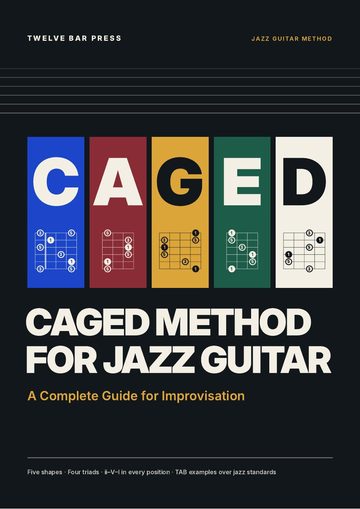
- One position of the major scale. If the neck still feels like a maze, the CAGED system for jazz guitar or triads across the neck will give you a map.
- The ability to read TAB. Standard notation helps, but it is not required to start.
- A metronome and a way to play chords behind you: a backing track, a looper pedal or a friend.
Step 1: Listen before you play
Jazz is an oral tradition. The books explain it; the records teach it. Before you practice a single scale, put on a recording and listen to how a jazz guitarist builds a solo. Notice three things: where the phrases start (often not on beat one), where they stop (usually on a strong chord tone) and how much silence there is between them.
Start with players whose lines are clear and singable: Charlie Christian, Wes Montgomery, Kenny Burrell and Jim Hall. Then try to sing one short phrase you liked. If you can sing it, you can learn to play it.
Step 2: Learn one progression well: the ii–V–I
The ii–V–I (two-five-one) is the most common chord progression in jazz standards. In the key of C it is Dm7 – G7 – Cmaj7: the chords built on the 2nd, 5th and 1st notes of the C major scale. The ii chord prepares, the V chord creates tension and the I chord resolves it. Once you can improvise over a ii–V–I, you can improvise over most of a standard, because standards are largely chains of ii–V–I’s in different keys.
Play the three chords slowly, four beats each, until you can change between them without stopping. Say the chord names out loud as you play. It sounds silly, but it trains your ear and your brain to know where you are in the progression — the single most important skill in jazz improvisation.
Step 3: Play the chord tones (arpeggios)
Every chord is made of four notes: the root (1), the 3rd, the 5th and the 7th. These are the chord tones, and they are the safest, strongest notes you can play over that chord. Playing them one after another is called an arpeggio.
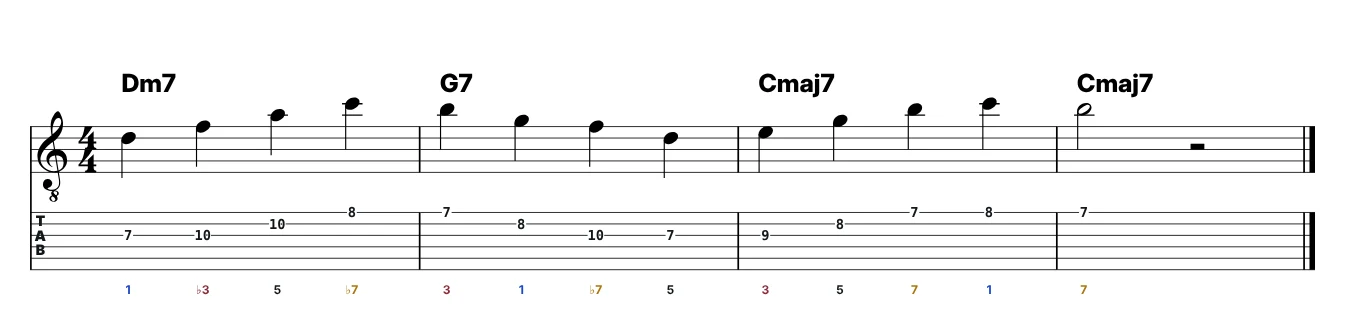
The example below plays the arpeggio of each chord in quarter notes, in one position around the 7th fret. Under the TAB you can see the degree of every note: 1, 3, 5 and 7. Notice that the line moves smoothly from chord to chord: you do not jump to a new root every time the chord changes.
Step 4: Make rhythm your first priority
Here is a secret most beginners discover late: a solo with few notes and great rhythm sounds better than a solo with many notes and stiff rhythm. Jazz eighth notes are swung: the first of each pair is a little longer than the second, like the rhythm of the word “ba-da, ba-da”. Phrases often start on an off-beat (the “and” of a beat), and rests are part of the phrase, not empty space.
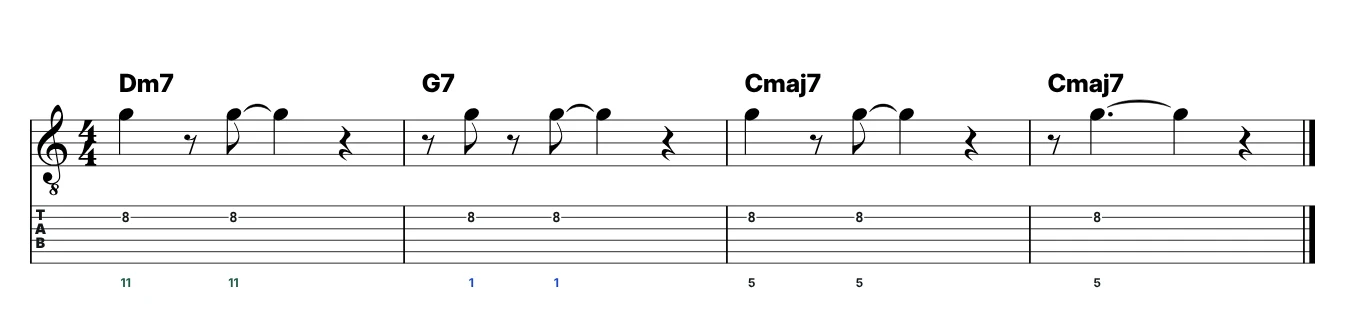
To prove it to yourself, play an entire chorus with just one note. In Example 2, the note G works over all three chords (it is the 11th of Dm7, the root of G7 and the 5th of Cmaj7), so all your attention can go to rhythm: short and long notes, off-beat starts, space.
Step 5: Add passing notes between the chord tones
Arpeggios alone can sound mechanical. The next step is to connect the chord tones with notes from the scale. A simple rule makes this sound like jazz right away: chord tones on the beats, scale notes between them. The beats are where the ear checks the harmony; the off-beats are where the line can travel.
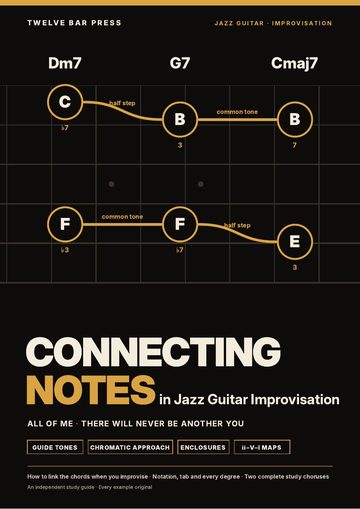
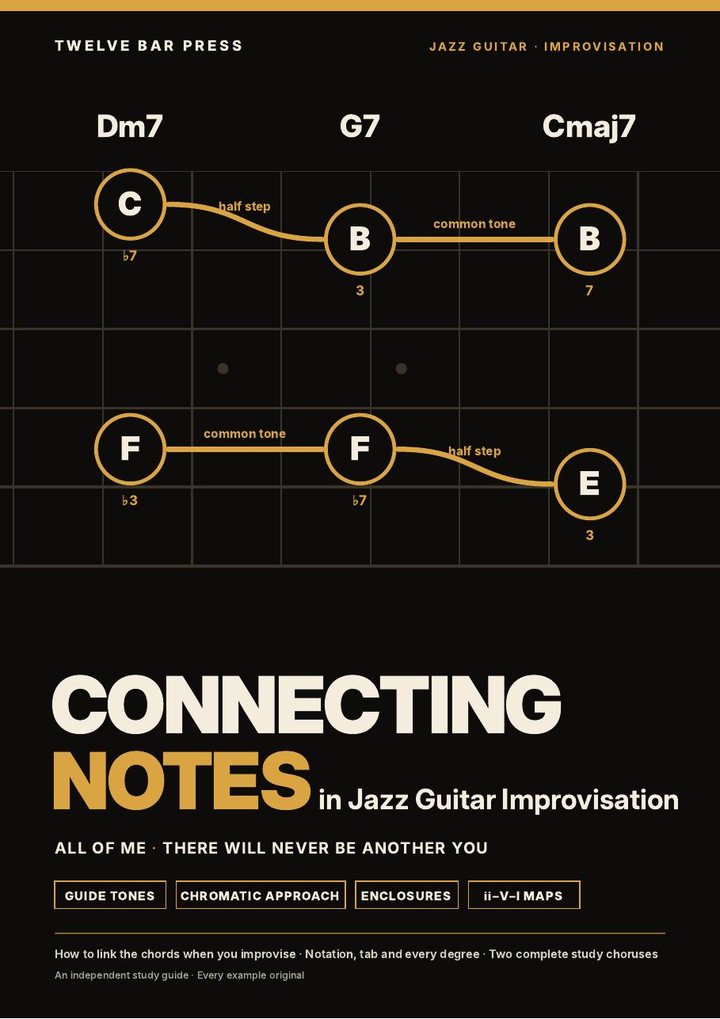
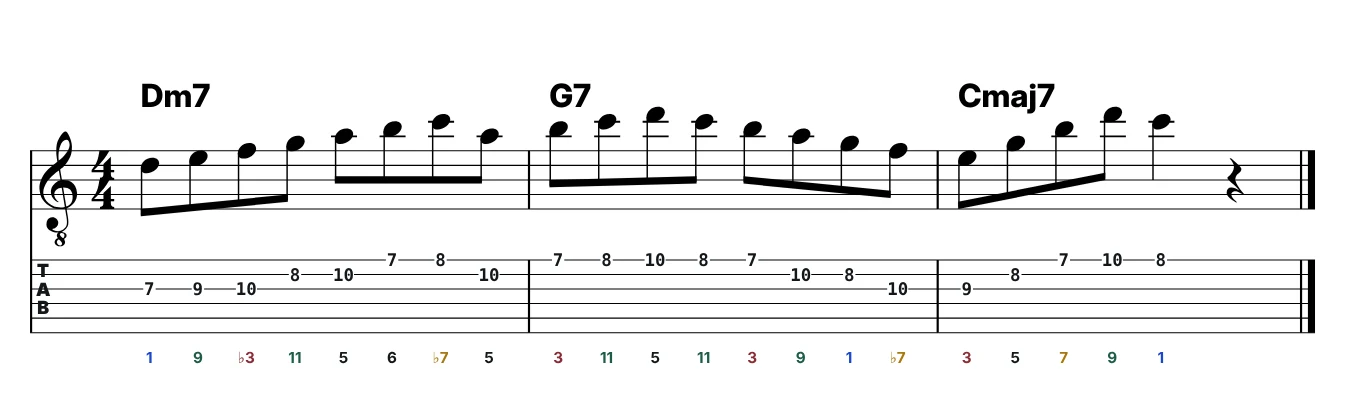
In Example 3, look at the degrees: on every beat of the Dm7 bar you find 1, 3, 5 and 7; the notes in between (E, G, B) are passing notes from the scale. Over G7 the beats fall on the 3rd, 5th, 3rd and root, and the line ends on F, the 7th of G7, which falls a half step to E, the 3rd of Cmaj7.
When you are comfortable with this rule, you can add chromatic passing notes — notes outside the scale that connect two scale notes a whole step apart. That is the core of the bebop sound, and it is explained in detail in our lesson on how to improvise over chord changes.
Step 6: Learn licks, then change them
A lick is a short phrase that works over a chord or a progression. Learning licks is how jazz musicians learn the language, the way you learn useful sentences in a foreign language before you write your own. The danger is playing them exactly the same way every time. The solution is to vary each lick as soon as you know it.
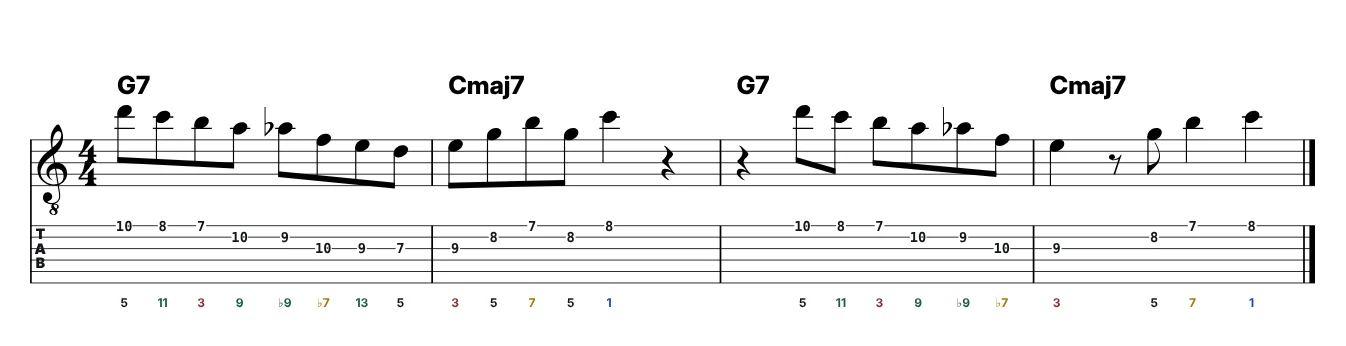
Example 4 shows a two-bar lick over G7 to Cmaj7 and then the same lick started one beat later. Nothing changed except where it begins, and yet it sounds like a new idea. Other ways to vary a lick: change its rhythm, start it from a different note of the chord, give it a new ending, or play it in another key.
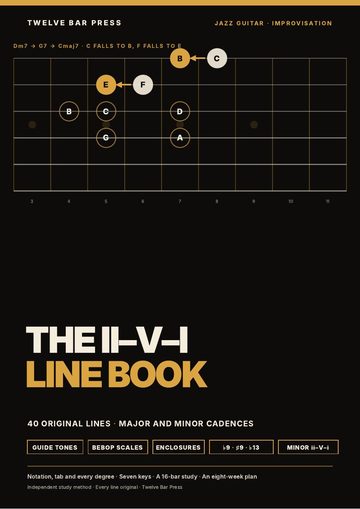
For a structured collection of lines, The II–V–I Line Book gives you 40 phrases over the major and minor ii–V–I, and Bebop Vocabulary adds 50 bebop lines with an analysis of each one.
Step 7: Put it together on a real tune
Now choose a simple form and improvise over it: a ii–V–I loop in C, then a 12-bar jazz blues in F. Think in four-bar phrases: play for two bars, rest for two. Use arpeggios, your passing-note lines and one or two licks. Record yourself, listen back the next day and keep the moments you like. Our guide on how to improvise a jazz guitar solo on a standard shows how to plan a whole chorus.
A 20-minute daily practice routine
| Minutes | What to practice | Goal |
|---|---|---|
| 0–3 | Listen to one solo and sing a phrase from it | Train your ear and your sense of phrasing |
| 3–8 | Arpeggios of the ii–V–I in one position | Know the chord tones without thinking |
| 8–12 | One-note and two-note solos over a backing track | Rhythm, swing and space |
| 12–16 | Lines with chord tones on the beat | Connect the chords smoothly |
| 16–20 | Free improvisation, recorded | Use what you practiced in real time |
Common mistakes beginners make
- Running scales up and down. A scale is a set of notes, not a melody. Start phrases from chord tones and change direction often.
- Never resting. Silence gives the listener time to hear what you just played. Leave space after every phrase.
- Ignoring the chord change. Know which chord comes next and aim for one of its chord tones on the downbeat.
- Learning licks in one key only. Move every lick to at least two more keys and positions.
- Practicing too fast. If you cannot play it cleanly at 60 on the metronome, you cannot use it at 160 on the bandstand.
Where to go next
Read how to improvise over chord changes to learn guide tones and approach notes, and what scales to use for jazz guitar to understand which scale fits each chord. When you want a complete, organized path, the Jazz Guitar Methods Collection brings eight method books together.
Frequently asked questions
How long does it take to learn jazz improvisation on guitar?
With 20 to 30 minutes of focused practice a day, most guitarists can improvise simple solos over a ii–V–I and a jazz blues within a few months. Developing a personal style takes years, which is part of the fun.
Do I need to read music to improvise on jazz guitar?
No. Many great jazz guitarists learned by ear. Reading TAB is enough to start; standard notation becomes useful later because it shows rhythm clearly.
What scale should I learn first for jazz improvisation?
Learn the major scale in one position and the arpeggios of the ii–V–I first. The Dorian and Mixolydian modes come from the same major scale, so you already know their notes.
Can I learn jazz improvisation on my own?
Yes, with good listening habits, a clear method and regular recording of your playing. A teacher or a structured book speeds things up by showing you what to practice and in what order.