Jazz Guitarists
Jim Hall: Biography of the Jazz Guitarist Who Made Every Note Count
Jim Hall (1930–2013) was an American jazz guitarist known for his lyrical, understated style and his development of short motifs into complete solos. He played with Chico Hamilton, Jimmy Giuffre and Sonny Rollins, recorded celebrated duets with pianist Bill Evans and bassist Ron Carter, and made Concierto (1975). He was named an NEA Jazz Master in 2004.
- Born
- December 4, 1930, Buffalo, New York
- Died
- December 10, 2013, New York City
- Full name
- James Stanley Hall
- Known for
- Duets with Bill Evans and Ron Carter; Sonny Rollins’ The Bridge
- Honor
- NEA Jazz Master (2004)
Early life: Buffalo, Cleveland and Charlie Christian
James Stanley Hall was born on December 4, 1930, in Buffalo, New York, and grew up in Cleveland. At thirteen, hearing Charlie Christian on a Benny Goodman record changed his life; he also copied solos by Barney Kessel. Just as important were tenor saxophonists such as Coleman Hawkins and Lester Young. He studied composition at the Cleveland Institute of Music and then moved to Los Angeles, where he also studied classical guitar.
Chico Hamilton, Jimmy Giuffre and Sonny Rollins
On the West Coast Hall joined the Chico Hamilton Quintet (1955–1956) and then worked on and off with Jimmy Giuffre’s trio from 1957 to 1960, in a quiet, chamber-like jazz without drums that suited his sound perfectly. In 1960 he toured Europe with Ella Fitzgerald.
In 1961 the saxophonist Sonny Rollins returned from a long retreat and chose Hall as his partner. Their album The Bridge (1962) is a classic of guitar–saxophone interplay.
Bill Evans, Art Farmer, Ron Carter and Concierto
Hall recorded five albums with the pianist Bill Evans between 1962 and 1966, including the duo album Undercurrent (1962), still the model for guitar–piano duets. He played in a group with the trumpeter Art Farmer (1962–1964) and was the featured soloist on six albums by the saxophonist Paul Desmond. With the bassist Ron Carter he recorded a series of duet albums, beginning with Alone Together (1972). Concierto (1975), with Paul Desmond and Chet Baker, was both an artistic and a commercial success.
In later years he recorded with younger guitarists who had grown up on his records, including Pat Metheny (1999). He was named an NEA Jazz Master in 2004, was still playing clubs and festivals at 81, and died in New York on December 10, 2013.
The Jim Hall sound: what defines his style
- Motivic development: he took a short idea and developed it — repeating, displacing, inverting, answering — until it became a whole solo.
- Space: silence was part of the music; he played fewer notes than almost anyone and made each one count.
- Conversation: in a duo he listened and responded, never simply accompanied.
- Comping and bass lines: small, moving voicings and harmonized bass lines that let him play without piano or bass.
- A soft, dark tone, played with a light touch on a hollow-body guitar.
Essential recordings
- Undercurrent (1962, with Bill Evans) — guitar–piano duo at its highest level.
- The Bridge (1962, Sonny Rollins) — Hall as the ideal partner.
- Alone Together (1972, with Ron Carter) — duo conversation with the bass.
- Concierto (1975) — his most famous album as a leader.
- Jim Hall & Pat Metheny (1999) — the master and one of his heirs.
What guitarists can learn from Jim Hall
- Build solos from motifs instead of licks.
- Use silence deliberately: rest as long as you play.
- Learn to comp in a duo: small voicings that leave room for the other musician.
- Play bass lines with chords when there is no bassist.
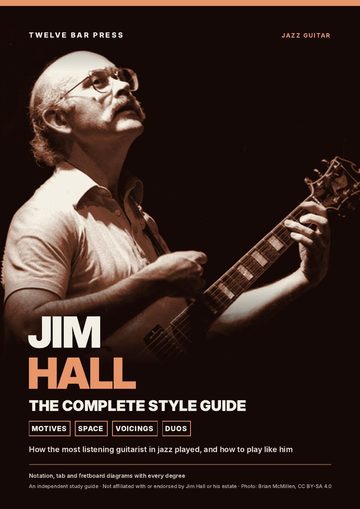
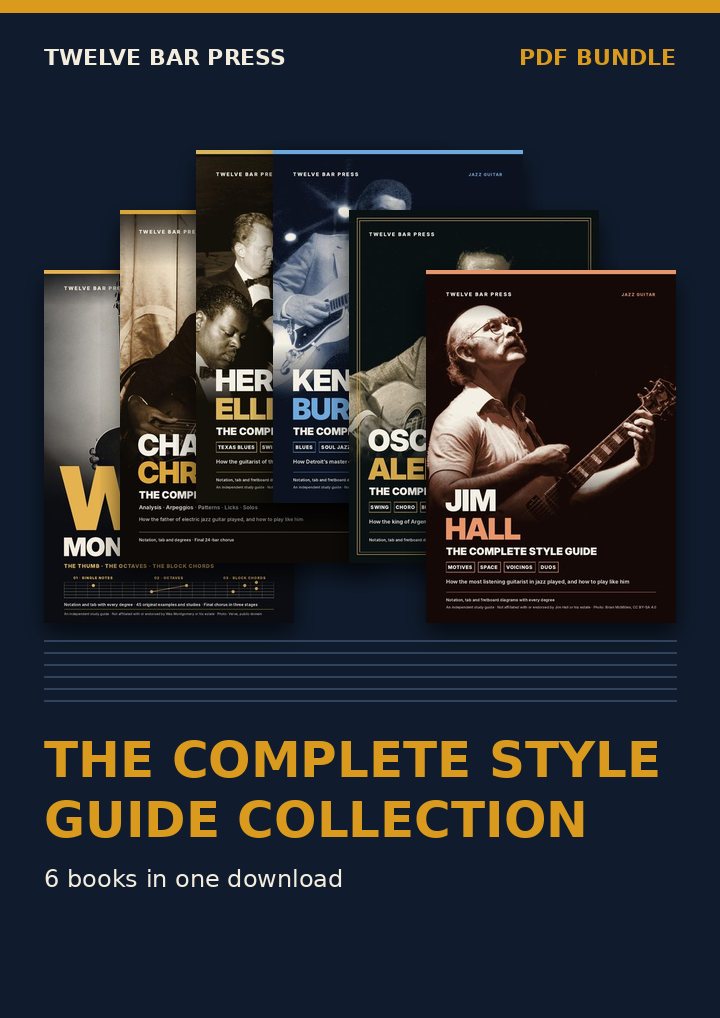
Our Jim Hall Guitar Style Guide teaches motivic development step by step, his comping and harmonized bass lines, and eight ii–V–I devices. To build a solo from a motif on a standard, read how to improvise a jazz guitar solo on a standard.
Frequently asked questions
What is Jim Hall known for?
For a lyrical, understated style built on developing short motifs, for his use of space, and for his duets with Bill Evans and Ron Carter.
What albums did Jim Hall make with Bill Evans?
Five albums between 1962 and 1966, including the duo album Undercurrent (1962).
Who influenced Jim Hall?
Charlie Christian and Barney Kessel among guitarists, and tenor saxophonists such as Coleman Hawkins, Lester Young and Lucky Thompson.