Jazz Guitar Lessons
How to Improvise a Jazz Guitar Solo on a Jazz Standard, Step by Step
To improvise a jazz guitar solo on a standard, learn the melody by ear, read the chord chart and group the chords into keys (usually ii–V–I’s), make a guide-tone map, then build your solo from one short motif that you develop through the form, giving the chorus a beginning, a climax and an ending. This guide walks through each step on the chord changes of “Autumn Leaves.”
Choose the right first standard
A good first standard has a clear melody, chords that change slowly and progressions you already know. Popular choices for beginners are “Autumn Leaves,” “Blue Bossa,” “All of Me,” “There Will Never Be Another You” and any 12-bar jazz blues. In this guide we use the chord progression of “Autumn Leaves” (Joseph Kosma, 1945), one of the most played jazz standards in the world. We only discuss its chords — the melody is protected by copyright and you should learn it from a recording.
Step 1: Learn the melody by ear
Every great jazz solo is, in some way, a comment on the melody. Learn the tune from a recording until you can sing it and play it in at least one position. You will notice that the melody itself is built on the guide tones of the chords — composers knew what they were doing — and quoting a fragment of it in your solo is one of the most effective ideas you can have.
Step 2: Read the chord chart and find the keys
Most standards are made of ii–V–I progressions in one or two keys. The first eight bars of “Autumn Leaves” in G minor contain exactly two of them: a major ii–V–I in B♭ (with one extra chord) and a minor ii–V–i in G minor. Seeing the chords this way reduces eight chords to two ideas.
| Bars | Autumn Leaves chords | Function | Key |
|---|---|---|---|
| 1–2 | Cm7 – F7 | ii – V | B♭ major |
| 3–4 | B♭maj7 – E♭maj7 | I – IV | B♭ major |
| 5–6 | Am7♭5 – D7 | ii – V (minor) | G minor |
| 7–8 | Gm6 | i | G minor |
Step 3: Make a guide-tone map
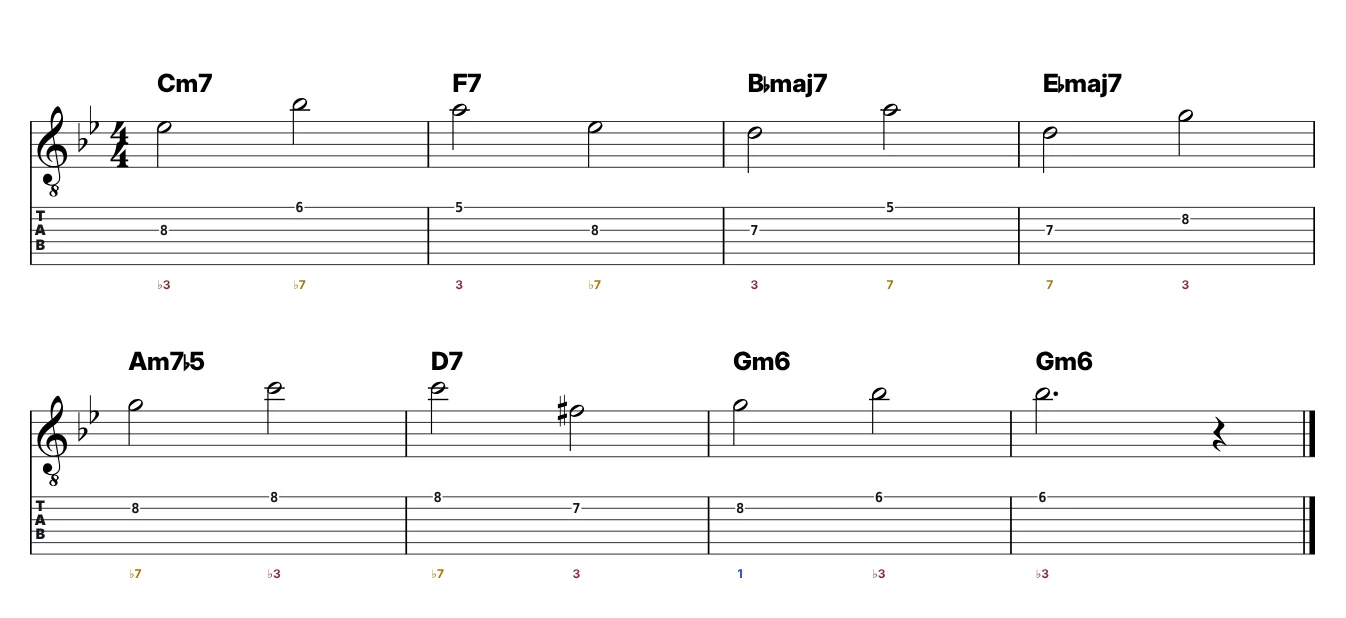
Before you improvise a single eighth note, play the 3rd and 7th of every chord in half notes through the form, as in Example 1. This is your map: it shows the smoothest path through the harmony, and every note in it is a strong target for your solo. Notice how many notes stay the same between chords (D for B♭maj7 and E♭maj7, G for E♭maj7 and Am7♭5, C for Am7♭5 and D7).
Step 4: Build the solo from one motif
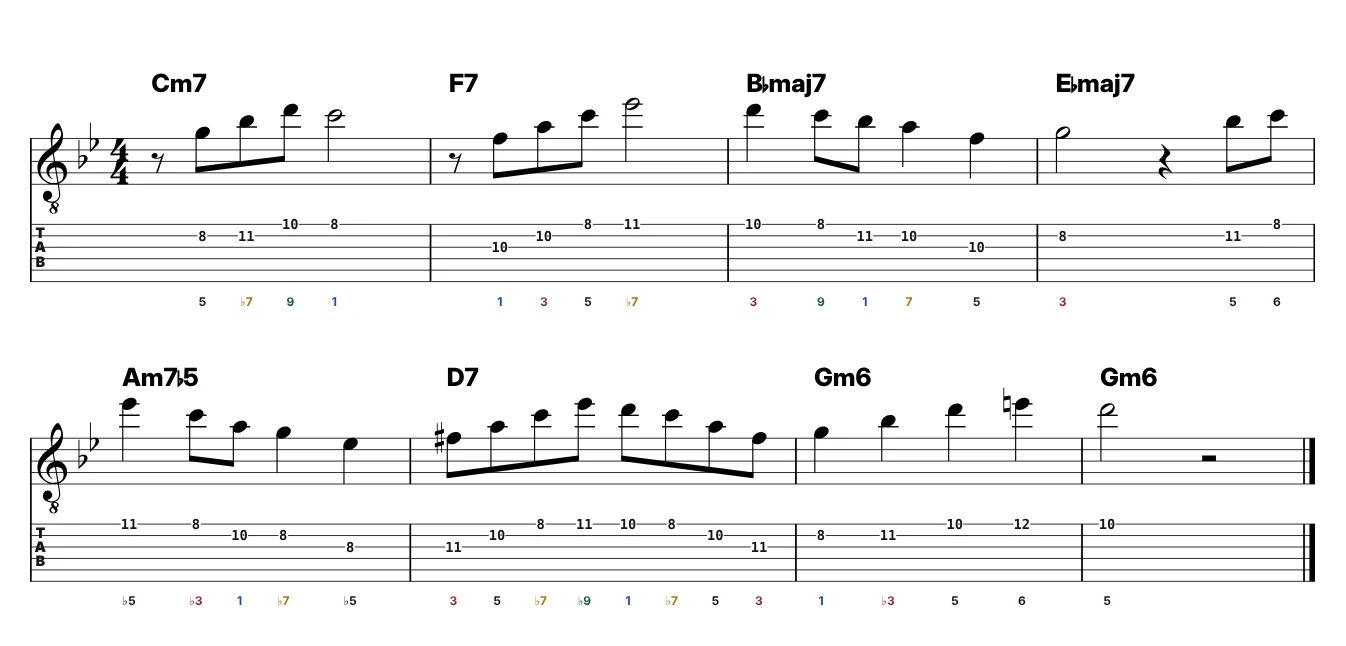
Here is the most important idea in this lesson: a great solo develops a few ideas instead of stringing many unrelated ones together. A motif is a short melodic cell — three or four notes with a recognizable rhythm. You state it, repeat it on the next chord with small changes, extend it, and then answer it with something different.
Example 2 is an eight-bar solo built this way. Bar 1 states the motif: a rest, then a rising arpeggio that lands on a long note. Bar 2 repeats the same shape on F7, one step lower. Bars 3–4 answer with a descending line and a pause. Bars 5–6 increase the energy with eighth notes and the ♭9 of D7. Bars 7–8 resolve on G minor with the 6th (E), the color of the Gm6 chord, and end on D.
| Bars | What happens | Device |
|---|---|---|
| 1–2 | The motif, then the same motif on the next chord | Sequence |
| 3–4 | A descending answer and a breath | Call and response, space |
| 5–6 | Continuous eighth notes with the ♭9 of D7 | Building intensity |
| 7–8 | Resolution on the 6th and 5th of Gm6 | Clear ending |
Step 5: Shape the whole chorus
A chorus of improvisation should have a shape, like a short story: a beginning that states an idea, a middle that develops it and a climax followed by a release. You can control that shape with four simple dials:
- Register: start in the middle of the guitar and save the highest notes for the climax.
- Density: begin with few notes and long rests; use continuous eighth notes later.
- Dynamics: play softer at the start, stronger at the peak.
- Harmony: stay inside the chords first; add tensions (♭9, ♯9, ♭13) as the solo grows.
Step 6: Practice with a backing track and record yourself
Play the guide-tone map first, then your motif in every bar, then free choruses. Record each session. The next day, listen back and write down one idea you liked and one problem to fix. This loop — play, record, listen, adjust — is how every jazz musician improves, and it works much faster than practicing in silence.
How long should a jazz guitar solo be?
On a jam session or a gig, one to three choruses is typical, depending on the tempo, the length of the tune and how many soloists there are. As a beginner, aim for one strong chorus with a clear shape. It is always better to leave the audience wanting more than to keep playing after your ideas have run out.
Common mistakes when soloing on a standard
- Not knowing the melody. Without it you lose your place in the form and miss the best ideas.
- Starting at full speed. Begin with space and simple ideas; you need somewhere to go.
- Playing a different idea in every bar. Repeat and develop. Repetition is what makes a solo memorable.
- Ignoring the minor ii–V–i. Bars 5–8 need different notes from bars 1–4. Learn both sounds.
Where to go next
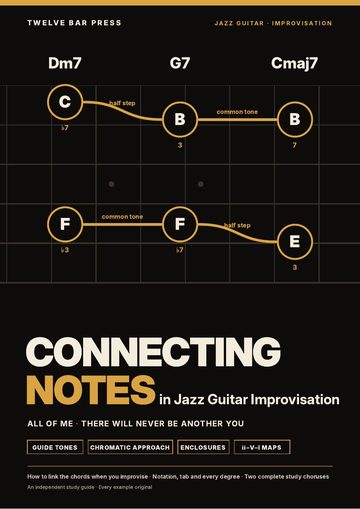
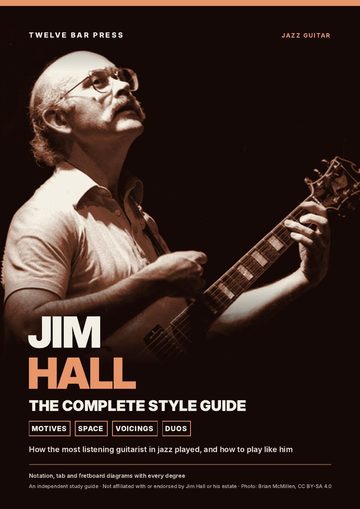
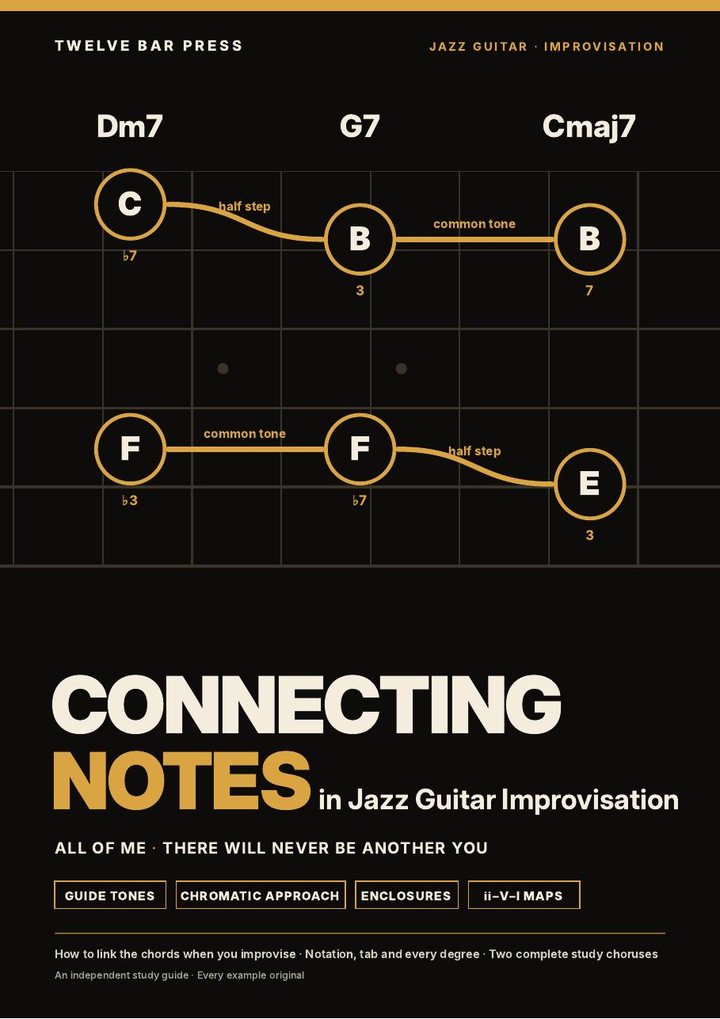
For two complete swing standards analyzed bar by bar, with full study choruses, see Connecting Notes in Jazz Guitar Improvisation. For the art of building a solo from a motif, study Jim Hall and our Jim Hall Guitar Style Guide. If you are just starting, read how to improvise on jazz guitar first.
Frequently asked questions
What is the easiest jazz standard to improvise on?
A 12-bar jazz blues, “Autumn Leaves” and “Blue Bossa” are usually the easiest, because they use a few ii–V–I progressions that repeat and change chords at a moderate pace.
What are the chords of Autumn Leaves?
In the common key of G minor, the first eight bars are Cm7 – F7 – B♭maj7 – E♭maj7 – Am7♭5 – D7 – Gm: a ii–V–I–IV in B♭ major followed by a minor ii–V–i in G minor.
Should I quote the melody in my jazz solo?
Yes, occasionally. A short quote of the melody, changed in rhythm or register, connects your solo to the tune and is one of the most musical devices in jazz.
How many choruses should a beginner solo for?
One well-shaped chorus is better than three long ones. Add choruses only when you have ideas to develop.