Jazz Guitar Lessons
What Scales to Use for Jazz Guitar: A Chord-by-Chord Guide
Jazz guitarists choose a scale for each chord rather than one scale for the whole tune. Over a minor 7 chord the usual choice is the Dorian mode; over a dominant 7, the Mixolydian mode (or the altered, diminished or bebop scale for more tension); over a major 7, the major scale or the Lydian mode. The chart and examples below show which scale fits each chord and how to make scales sound like music instead of exercises.
The short answer: a chord-scale chart
This chart covers the chords you will meet in nine out of ten jazz standards. The “character note” is the note that gives each scale its color; emphasize it and the scale sounds like itself.
| Chord | Scale | Notes (example) | Character note |
|---|---|---|---|
| m7 (Dm7) | Dorian mode | D E F G A B C | natural 6th (B) |
| 7 (G7) | Mixolydian mode | G A B C D E F | ♭7 (F) with major 3rd (B) |
| maj7 (Cmaj7) | Major scale (Ionian) | C D E F G A B | major 7th (B) |
| maj7 (Cmaj7) | Lydian mode | C D E F♯ G A B | ♯11 (F♯) |
| 7 resolving to minor (G7alt) | Altered scale | G A♭ B♭ B D♭ E♭ F | ♭9, ♯9, ♭13 |
| 7♭9 (G7♭9) | Half-whole diminished | G A♭ B♭ B C♯ D E F | ♭9 with natural 13th |
| m7♭5 (Bm7♭5) | Locrian ♮2 | B C♯ D E F G A | natural 9th (C♯) |
| dim7 (B°7) | Whole-half diminished | B C♯ D E F G A♭ B♭ | symmetrical, every 3 frets |
| m6 / m(maj7) (Cm6) | Melodic minor | C D E♭ F G A B | natural 6th and 7th |
The three core scales of the ii–V–I
Here is the good news: the three most important jazz scales are one scale. In the key of C, D Dorian, G Mixolydian and C major contain exactly the same seven notes. What changes is the chord underneath and, therefore, which notes are chord tones and which are colors. That is why you should learn them as one fingering with three different “centers” rather than as three separate shapes.
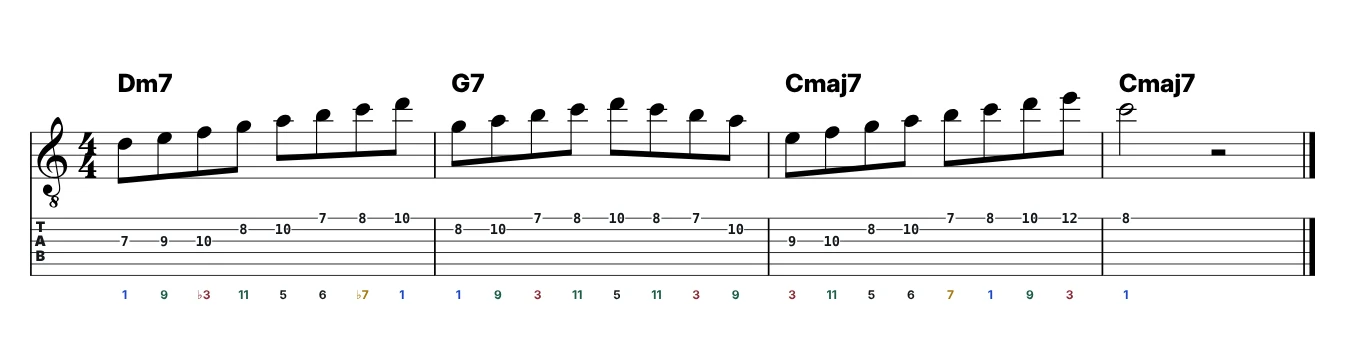
The Dorian mode on guitar (minor 7 chords)
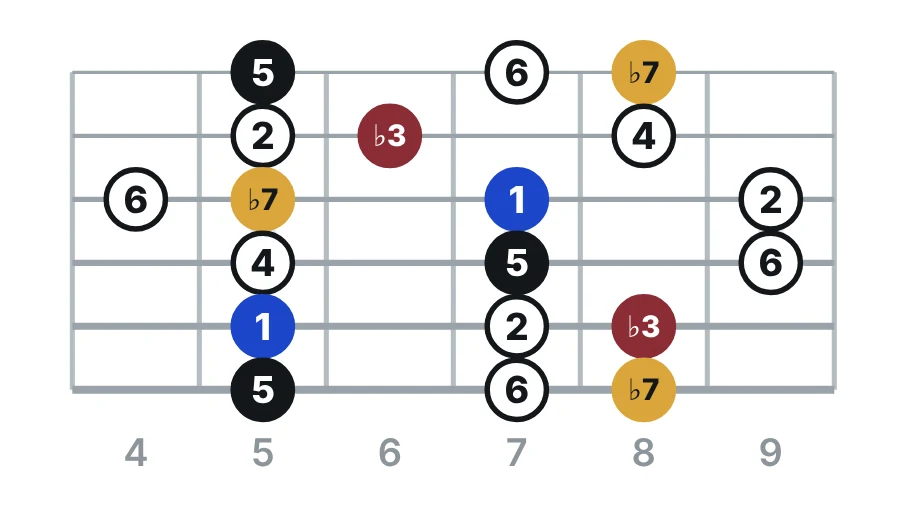
The Dorian mode is a minor scale with a natural 6th. Over Dm7 it gives you D, E, F, G, A, B, C. Compared with the natural minor scale, that B natural brightens the sound; it is the note that makes Dorian sound like Dorian, and the reason this mode is the first choice for minor 7 chords in jazz. Play the 6th on a strong beat and resolve it, and you will hear the color immediately.
The Mixolydian mode (dominant 7 chords)
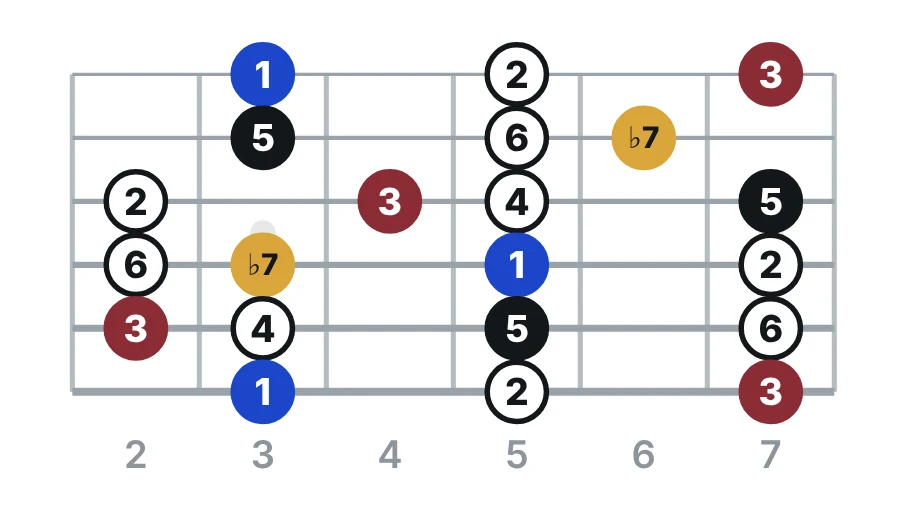
The Mixolydian mode is a major scale with a ♭7, and it matches the dominant 7 chord exactly: G, A, B, C, D, E, F over G7. The most important notes are the 3rd (B) and the ♭7 (F), which form the tritone that wants to resolve. One warning: the 4th of the scale (C over G7) clashes with the 3rd if you hold it on a strong beat. Use it as a passing note, not as a destination.
Major scale and Lydian mode (major 7 chords)
Over a major 7 chord, the major scale (Ionian mode) is the natural choice. Its 4th (F over Cmaj7) has the same problem as in Mixolydian: it sounds unresolved on a strong beat. Many jazz musicians therefore prefer the Lydian mode, which raises that note to F♯, the ♯11. The result is brighter and more modern, and it never clashes.
The bebop scales
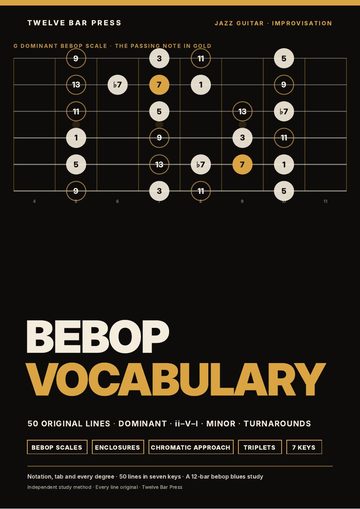
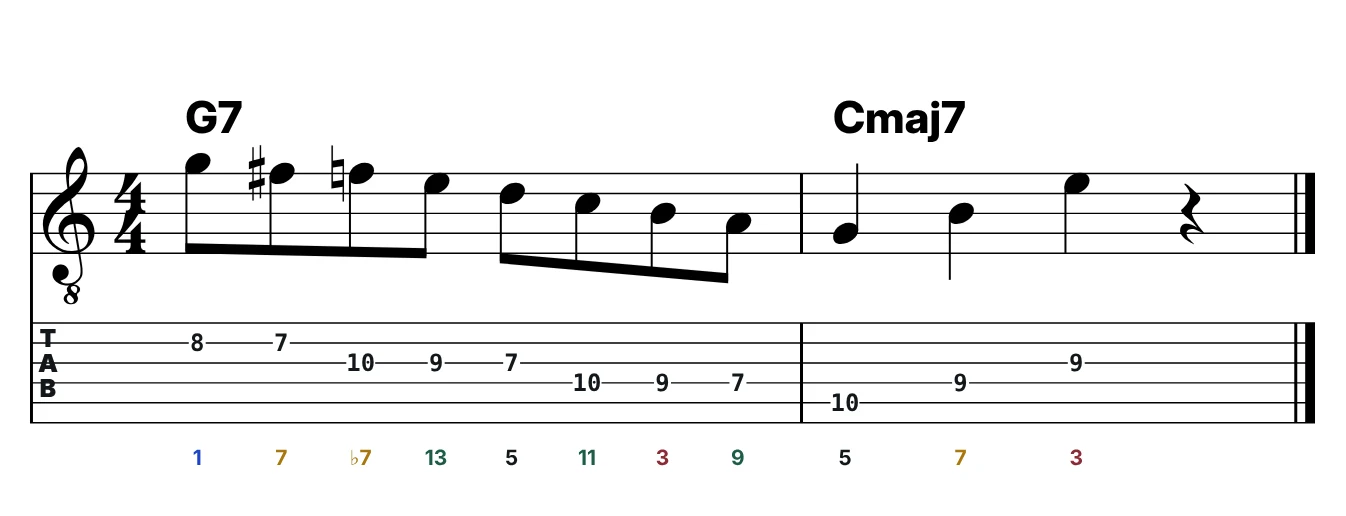
Bebop musicians added one chromatic passing note to the Mixolydian and major scales so that, when you play the scale in eighth notes starting from a chord tone, the chord tones fall on the beats. The dominant bebop scale adds the major 7th between the ♭7 and the root: G, F♯, F, E, D, C, B, A over G7. Read the degrees in Example 2 — root, ♭7, 5th and 3rd land on beats one to four.
Our book Bebop Vocabulary: 50 Lines shows how bebop players turn these scales into real phrases.
The altered scale
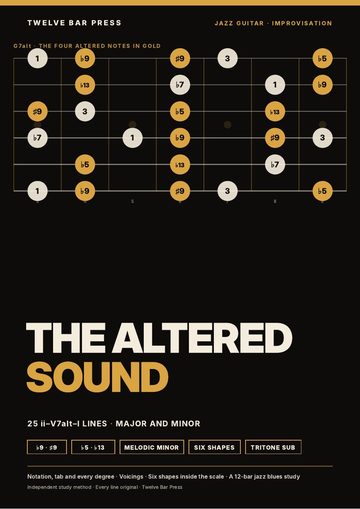
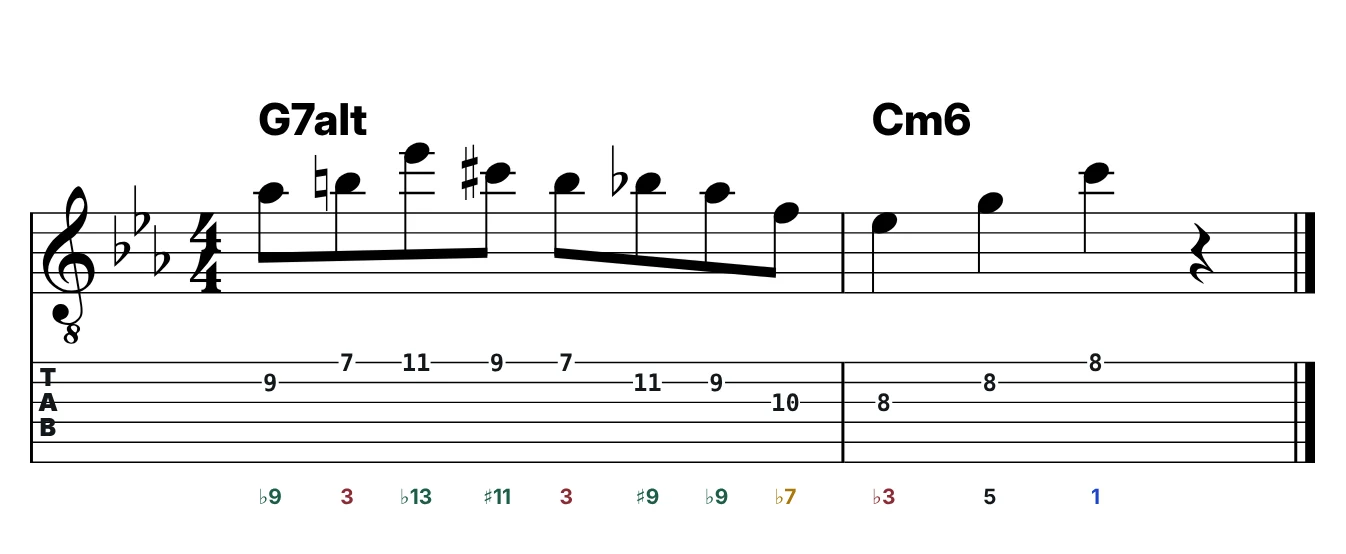
When a dominant chord resolves to a minor chord, or the chart says “7alt”, jazz players reach for the altered scale (also called the super Locrian mode, the 7th mode of melodic minor). It keeps the root, the 3rd and the ♭7 of the dominant chord and alters everything else: ♭9, ♯9, ♭5 and ♭13. The result is maximum tension, which makes the resolution sound stronger. In Example 3, the line uses an A♭ minor shape over G7 and resolves to C minor.
The whole subject — where the scale comes from, six shapes inside it and how each altered note resolves — is in The Altered Sound.
The diminished scales
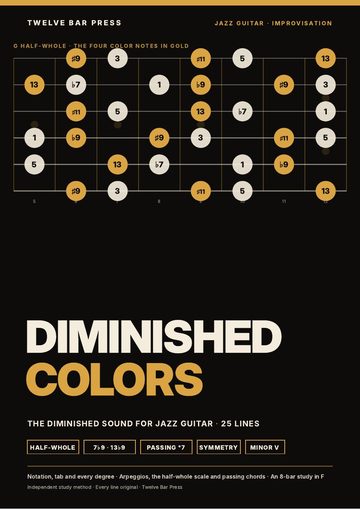
The half-whole diminished scale alternates half steps and whole steps from the root. Over a G7♭9 it gives the ♭9, ♯9, ♯11 and the natural 13th — a brighter tension than the altered scale. The whole-half diminished scale starts with a whole step and fits diminished seventh chords. Both scales are symmetrical: every shape repeats three frets higher, which makes them surprisingly easy on the guitar. Diminished Colors covers both, with 25 lines.
Pentatonic and blues scales in jazz
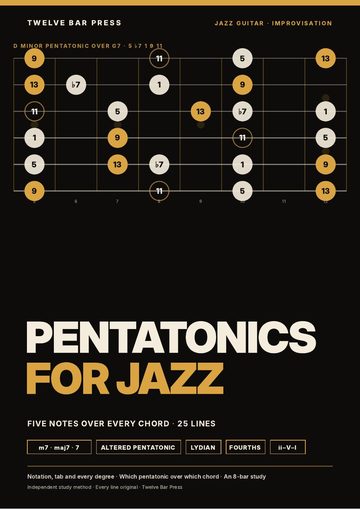
You do not have to leave the pentatonic scale behind. Jazz guitarists use it by starting it on a different note of the chord: over Dm7, D minor pentatonic gives the root, ♭3, 4, 5 and ♭7, while A minor pentatonic gives the 9th and 11th; over G7, B♭ minor pentatonic gives altered tensions. The blues scale (minor pentatonic plus ♭5) is the sound of the jazz blues. See Pentatonics for the Jazz Guitarist and Blues Language for Jazz Guitar.
Scales for the minor ii–V–i
In a minor key, the ii chord is half-diminished (Bm7♭5 in A minor) and the V chord is a dominant with a ♭9 (E7♭9). Use Locrian ♮2 on the m7♭5 chord, the altered, half-whole diminished or Phrygian dominant (the 5th mode of harmonic minor) on the V7, and Dorian or melodic minor on the minor i chord.
How to practice scales so they sound like jazz
- Start from chord tones, not from the root of the scale.
- Play in thirds (1-3, 2-4, 3-5…) to break the step-by-step habit.
- Change direction often; a line that only goes up sounds like an exercise.
- Stay in one position and learn the scale over the whole fretboard area, then move to the next position.
- Always practice over a chord — a backing track or a looper — so your ear connects each note to its function.
Which jazz scales to learn first
- The major scale in one position, heard as Dorian, Mixolydian and Ionian over a ii–V–I.
- The arpeggios of m7, 7 and maj7 chords in the same position.
- The dominant bebop scale.
- The minor pentatonic and blues scale over jazz chords.
- The altered scale and the half-whole diminished scale.
- Melodic minor and its modes, for the minor ii–V–i.
Frequently asked questions
What is the most important scale in jazz?
The major scale, because the Dorian, Mixolydian and Ionian modes — the scales of the ii–V–I — all come from it. Most jazz musicians learn it first and hear it in three ways.
Is the Dorian mode used in jazz?
Yes. Dorian is the standard choice over minor 7 chords, especially the ii chord of a ii–V–I and modal tunes. Its natural 6th gives it a brighter minor sound.
What scale do you play over a dominant chord in jazz?
The Mixolydian mode is the basic choice. For more tension, use the bebop dominant scale, the altered scale (especially when the chord resolves to minor) or the half-whole diminished scale over 7♭9 chords.
Do jazz guitarists think in modes?
Many do at first, but most experienced players think in chord tones and use scales to connect them. Modes are a useful map; the music happens in the lines you build on top of them.