Jazz Guitar Methods Collection
$37.99$64.92
Methods & Technique
The altered scale for jazz guitar: where it comes from, what it contains and how it resolves
Jazz Guitar Books. Online store · 20 pages · PDF · Updated
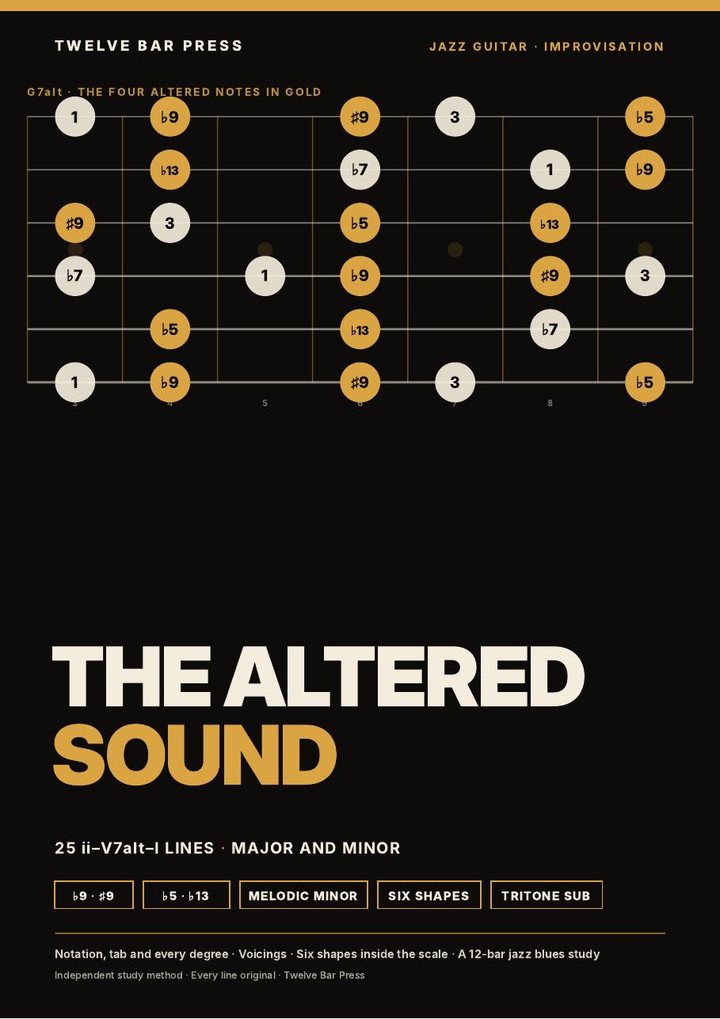
The Altered Sound is a 20-page PDF jazz guitar method book from Jazz Guitar Books. Online store that teaches the altered scale (super Locrian) over dominant chords: where it comes from, the six shapes inside it and how its notes resolve. It includes voicings, fingerings, 25 lines and a 12-bar jazz blues study. Every example is written in standard notation, TAB and chord degrees, for intermediate to advanced guitarists.
The altered scale — also called super Locrian, the seventh mode of melodic minor — is the sound of tension and release on a dominant chord. The Altered Sound explains the altered scale for guitar from the ground up: where it comes from, what each of its notes does over a V7 chord and, above all, how the altered notes resolve.
You get altered dominant voicings, fingerings across the neck, six shapes hidden inside the scale, 25 lines in C, F, B♭ and in minor keys, and Altered Avenue, a 12-bar jazz blues study.
Every example is printed in standard notation with rhythm, guitar TAB and the degree of every note, so ♭9, ♯9, ♭5 and ♭13 become sounds you recognize, not just numbers.
For intermediate to advanced players who can already play over a ii–V–I and want the modern, tense sound of altered dominants.
Each example is written in standard notation with its rhythm (guitar sounds an octave lower than written) and in TAB, with the degree of every note against the chord printed under it and colored by function. Fretboard diagrams show shapes and positions.
The PDF is licensed to the buyer for personal study. You may print it for your own use and keep it on all your devices. See the license terms.
Yes. Both names describe the 7th mode of the melodic minor scale: root, ♭9, ♯9, 3, ♭5, ♭13 and ♭7.
Over a dominant chord that resolves, especially V7 to a minor chord or a V7 marked alt, ♭9 or ♯9.
Yes, altered dominant voicings are shown alongside the scale shapes.