Jazz Guitarists
Wes Montgomery: Biography, Thumb Technique and the Art of Octaves
Wes Montgomery (1923–1968) was an American jazz guitarist from Indianapolis, famous for playing with his thumb instead of a pick and for his use of octaves and block chords. Self-taught from Charlie Christian records, he played with Lionel Hampton, recorded classic albums for Riverside such as The Incredible Jazz Guitar of Wes Montgomery (1960), and later won a Grammy for Goin’ Out of My Head.
- Born
- March 6, 1923, Indianapolis, Indiana
- Died
- June 15, 1968, Indianapolis
- Full name
- John Leslie Montgomery
- Known for
- Thumb technique, octaves, block chords
- Award
- Grammy for Goin’ Out of My Head
Early life: Charlie Christian records and the thumb
John Leslie “Wes” Montgomery was born on March 6, 1923, in Indianapolis. He picked up the guitar at 19, after hearing a Charlie Christian record, and taught himself mostly by copying Christian’s solos note for note.
He worked a day job and practiced late at night. To keep the volume down for his neighbors and his family, he stopped using a pick and played with the side of his thumb. That choice, born of necessity, gave him the warm, round tone that made him famous.
Lionel Hampton, the Montgomery Brothers and Riverside
In 1948 the vibraphonist Lionel Hampton hired him, and Wes toured with the band for about two years. Back in Indianapolis, he played in local clubs and with his brothers, the bassist Monk and the pianist and vibraphonist Buddy, as the Montgomery Brothers.
The saxophonist Cannonball Adderley heard him in Indianapolis and was so impressed that he persuaded Orrin Keepnews to sign him to Riverside Records. The Incredible Jazz Guitar of Wes Montgomery (1960) announced a new voice on the instrument, and live albums such as Full House (1962) showed how hard he could swing.
Verve, A&M and success
With the producer Creed Taylor, at Verve and later at A&M, Wes reached a much larger audience with orchestral and pop-oriented albums. He won a Grammy for Goin’ Out of My Head, and records such as A Day in the Life (1967) sold far beyond the jazz world. At the same time he kept recording hard-swinging jazz, such as Smokin’ at the Half Note (1965) with the Wynton Kelly Trio. He died of a heart attack at home in Indianapolis on June 15, 1968, at 45.
The Wes Montgomery sound: thumb, octaves and block chords
Wes often built a solo in three stages, and this structure is the best way to understand his style:
- Single-note lines, played with the thumb, bluesy and full of bebop vocabulary.
- Octaves: the same note on two strings, with the string in between muted. The two notes fuse into one big, singing sound.
- Block chords: the melody harmonized with full chords, for the climax of the solo.
Each stage raises the intensity, so the solo grows naturally from a conversation to a shout. Add his blues phrasing, his lines through the ii–V–I and his love of the minor blues, and you have the complete Wes sound.
Essential recordings
- The Incredible Jazz Guitar of Wes Montgomery (1960) — the classic starting point.
- Full House (1962) — live, with Johnny Griffin on tenor saxophone.
- Smokin’ at the Half Note (1965) — with the Wynton Kelly Trio; essential for octave solos.
- Goin’ Out of My Head — his Grammy-winning album with orchestra.
- A Day in the Life (1967) — Wes the hit-maker.
What guitarists can learn from Wes Montgomery
- Build every solo with a shape: start simple and let the intensity grow.
- Learn octaves on the 6–4 and 5–3 string pairs (two frets apart) and the 4–2 and 3–1 pairs (three frets apart).
- Harmonize a melody with block chords on the top four strings.
- Spend time on the minor blues, one of his favorite forms.
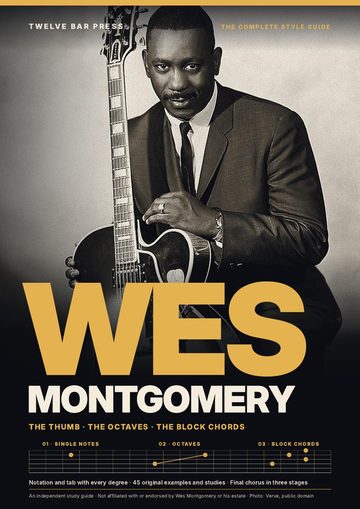
Our Wes Montgomery Guitar Style Guide follows his three-stage solo chapter by chapter, with the thumb technique, octaves, block chords and a minor blues chapter. Wes learned from Charlie Christian and was a major influence on Pat Martino.
Frequently asked questions
Why did Wes Montgomery play with his thumb?
He practiced late at night and started using his thumb instead of a pick to play more quietly for his neighbors and family. It gave him his warm, round tone.
How do you play Wes Montgomery octaves?
Play the same note on two strings with one string muted between them: two frets apart on the 6–4 and 5–3 string pairs, three frets apart on the 4–2 and 3–1 pairs. Mute the middle string with the first finger and strike with the thumb.
What is the best Wes Montgomery album to start with?
The Incredible Jazz Guitar of Wes Montgomery (1960) and Smokin’ at the Half Note (1965) are the most recommended starting points for guitarists.