Jazz Guitarists
Pat Martino: Biography of the Guitarist Who Relearned Jazz Guitar from Zero
Pat Martino (1944–2021), born Patrick Azzara, was an American jazz guitarist from Philadelphia known for long, fluid eighth-note lines and his method of “minor conversion.” He rose through the organ-trio scene and recorded El Hombre (1967). In 1980, surgery after a brain hemorrhage left him with amnesia; he relearned the guitar and returned with The Return (1987), recording until the late 2010s.
- Born
- August 25, 1944, Philadelphia, Pennsylvania
- Died
- November 1, 2021, Philadelphia
- Birth name
- Patrick Carmen Azzara
- Known for
- Long, flowing lines; minor conversion; his comeback after amnesia
- Autobiography
- Here and Now! (2011, with Bill Milkowski)
A Philadelphia prodigy
Patrick Carmen Azzara was born on August 25, 1944, in South Philadelphia. He studied with the Philadelphia teacher Dennis Sandole, who also taught John Coltrane, and at fifteen moved to Harlem to play with his heroes. As a young man he worked in the organ-trio scene, with organists such as Jack McDuff, Don Patterson, Richard “Groove” Holmes and Trudy Pitts — an ideal school for swing, blues and long, burning solos.
El Hombre and the Prestige and Muse years
His first album as a leader, El Hombre (Prestige, 1967), was followed by Strings! (1967), East! (1968) and Baiyina (1968), which mixed jazz with Indian music. In the 1970s, on the Muse label, he recorded some of his most admired albums: Live!, Consciousness and Exit.
1980: the brain surgery and the long way back
In 1980 Martino suffered a brain hemorrhage caused by an arteriovenous malformation he had had since birth. Surgery saved his life, but it left him with amnesia: he no longer remembered his career, his records or how to play the guitar. Over several years he relearned the instrument, partly by listening to his own old recordings. He returned with The Return (Muse, 1987) and went on to record for Blue Note and HighNote, including Remember: A Tribute to Wes Montgomery (2006). In his autobiography he called the aneurysm “the greatest thing that ever happened to me.”
Respiratory illness stopped him from playing after 2018. He died on November 1, 2021, at 77, in the South Philadelphia house where he grew up.
The Pat Martino sound: what defines his style
- Long, continuous eighth-note lines, played with a strong, even attack.
- Minor conversion: he related every chord to a minor sound, so one vocabulary covered many chords.
- Organ-trio intensity: repetition, rhythmic drive and long climaxes.
- A geometric view of the fretboard: he saw the guitar as symmetrical shapes, especially diminished and augmented ones.
Essential recordings
- El Hombre (1967) — his debut as a leader.
- East! (1968) — modal and exploratory.
- Live! and Consciousness (Muse, 1970s) — Martino at full speed.
- The Return (1987) — the comeback.
- Remember: A Tribute to Wes Montgomery (2006) — homage to a hero.
What guitarists can learn from Pat Martino
- Learn to play long eighth-note lines with an even attack and no gaps.
- Use minor conversion to simplify the harmony of a tune.
- Practice one minor line over several chords and hear how its meaning changes.
- Study the organ-trio repertoire: blues, ballads and burning up-tempo tunes.
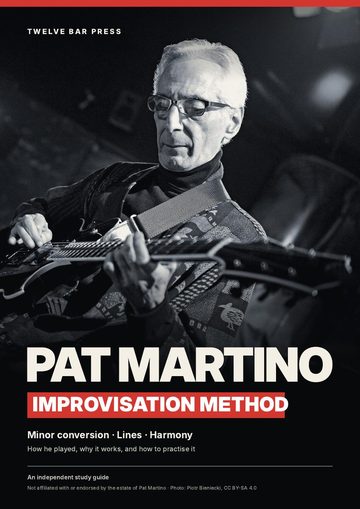
Our Pat Martino Improvisation Method explains minor conversion simply, with one line over five chords and five areas of G minor on the neck. It is an independent study guide, not affiliated with Pat Martino or his estate.
Frequently asked questions
What happened to Pat Martino in 1980?
He had surgery after a brain hemorrhage caused by an arteriovenous malformation. The operation saved his life but left him with amnesia, and he had to relearn the guitar.
What is Pat Martino’s minor conversion?
A way of relating each chord to a minor sound — for example, thinking G minor over both Gm7 and C7 — so that one minor vocabulary covers many chords.
What was Pat Martino’s comeback album?
The Return, recorded for Muse in 1987, after he relearned the guitar.