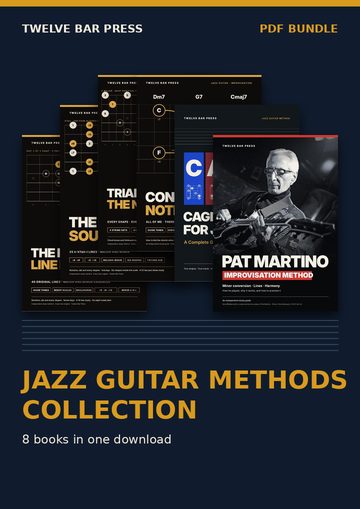
Jazz Guitar Methods Collection
$37.99$64.92
Methods & Technique
Minor conversion, lines and harmony: an independent study guide
Jazz Guitar Books. Online store · 12 pages · PDF · Updated
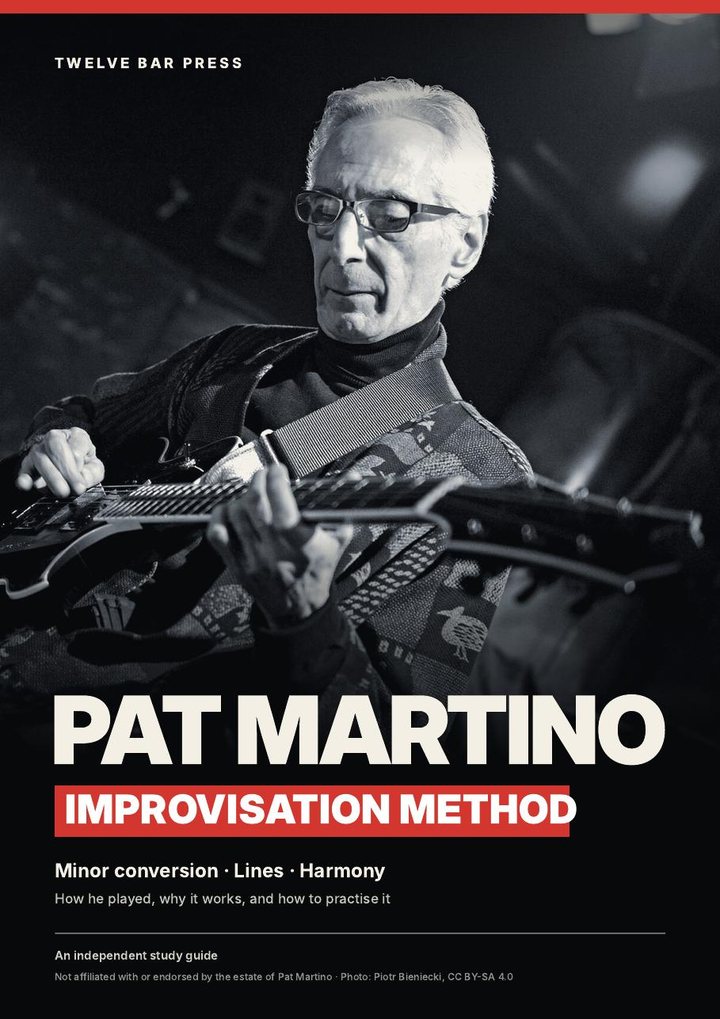
Pat Martino Improvisation Method is a 12-page PDF jazz guitar method book from Jazz Guitar Books. Online store that teaches Pat Martino’s minor conversion: relating each chord to a minor sound so one vocabulary covers many chords. It includes one line over five chords, five areas of G minor on the neck and lines over real changes. Every example is written in standard notation, TAB and chord degrees, for intermediate to advanced guitarists.
Pat Martino simplified jazz harmony to one idea: play the minor sound that fits the chord. This independent Pat Martino improvisation method explains minor conversion in plain language and shows one minor line working over five different chords.
It maps five areas of G minor across the neck — the way Martino saw the guitar — and then applies the method to real changes: the ii–V–I, the minor ii–V and tunes with repeated chords, with lines and a practice plan.
Every example is in standard notation with rhythm, guitar TAB and the degree of every note.
For intermediate to advanced players who want a simpler way to think about jazz harmony when they solo, and for fans of Pat Martino’s long, flowing lines.
Each example is written in standard notation with its rhythm (guitar sounds an octave lower than written) and in TAB, with the degree of every note against the chord printed under it and colored by function. Fretboard diagrams show shapes and positions.
The PDF is licensed to the buyer for personal study. You may print it for your own use and keep it on all your devices. See the license terms.
Pat Martino’s idea of relating every chord to a minor sound — for example, thinking G minor over both Gm7 and C7, D minor over Fmaj7 and G minor over Em7♭5 — so one vocabulary covers many chords.
No. It is an independent study guide with examples; it is not affiliated with Pat Martino or his estate.
A compact 12-page PDF focused on one method.