Jazz Standards Analyzed
Jazz Song Forms Explained: AABA, ABAC, AAB and the 12-Bar Blues
Most jazz standards use a few song forms. The most common is the 32-bar AABA form: four eight-bar sections, where the A section is played three times and the B section, called the bridge, once. Other common forms are ABAC (32 bars, the second half starting like the first), AAB (8 + 8 + 16 bars), the 12-bar blues and 16-bar tunes. Knowing the form tells you where you are in the song at every moment.
Why the form matters when you improvise
A jazz performance usually goes like this: the band plays the melody (the head) once, the soloists improvise over the same chords for one or more choruses, and the band plays the head again to finish. Every chorus follows the form of the song. If you know the form, you always know where you are: in the first A, in the bridge, in the last bars. If you lose the form, you get lost — and the whole band hears it.
Forms are named with letters. Each letter is a section, usually eight bars long; sections with the same letter have the same (or almost the same) melody and chords.
The 32-bar AABA form
This is the classic form of the Great American Songbook. The A section states the main theme. It repeats, often with a slightly different ending. The B section — the bridge or release — brings contrast: a new melody and usually a move to a different key. Then the A section comes back one last time.
Famous AABA standards include “I Got Rhythm” (George Gershwin, 1930), whose chords — known as rhythm changes — are, with the blues, the most played progression in jazz, “Honeysuckle Rose,” “Take the ‘A’ Train” and “Satin Doll.”
The ABAC form
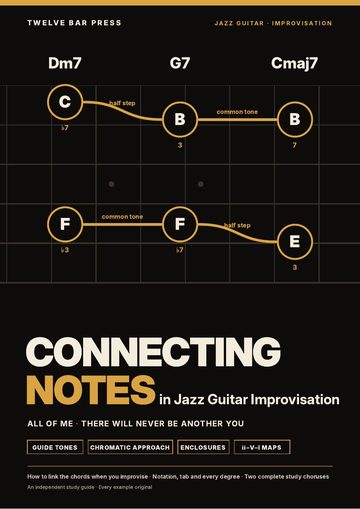
In ABAC tunes the song is divided into two halves of sixteen bars. Both halves begin with the same A section; the first half continues with B, the second with C, which leads to the final cadence. “All of Me” and “There Will Never Be Another You” are perfect examples — see our analyses of All of Me and There Will Never Be Another You.
The AAB form (and why some call it AABC)
Some songs repeat the A section and then finish with one long section of sixteen bars. “Autumn Leaves” is the best-known example. Because the last sixteen bars contain two different eight-bar phrases, some lead sheets label the form AABC. The name matters less than knowing what happens: see our Autumn Leaves chords analysis.
The 12-bar blues
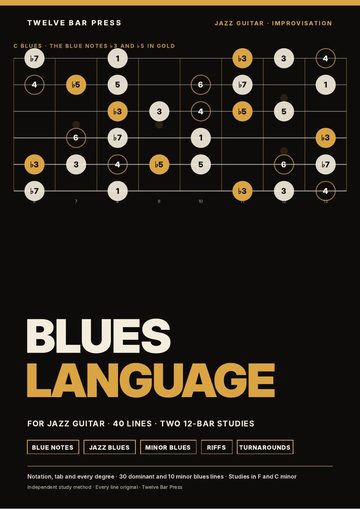
The blues is not a 32-bar song but a twelve-bar form, divided into three lines of four bars. In its jazz version it adds ii–V’s and passing chords, but the three-line shape is always there. It is the most played form in jazz, from Count Basie to bebop to soul jazz, and the best place to start improvising. Learn it with Blues Language for Jazz Guitar and Jazz Blues Comping Studies.
Other forms: 16 bars, intros, tags and codas
- 16-bar tunes, such as “Blue Bossa,” are shorter forms, often in two halves of eight bars.
- Intro: a short introduction before the head, often four or eight bars.
- Turnaround: the last two bars of a chorus (often I–VI–ii–V) that lead back to the top of the form.
- Tag and coda: endings, often repeating the last phrase or the last turnaround several times.
How to never get lost in the form
- Sing the melody silently while you solo: the melody tells you where you are.
- Mark the first bar of each section with a clear idea — a high note, a rest, a new rhythm.
- Learn the landmark chords: the first chord of the bridge, the last chord of each section.
- Practice section by section: first A alone, then A to A, then A to B.
- When you get lost, stop playing and listen to the bass. Come back in at the next section.
Frequently asked questions
What is AABA form in jazz?
A 32-bar song form with four eight-bar sections: the A section is played twice, followed by a contrasting B section (the bridge), and then A once more. It is the most common form of jazz standards.
What is the bridge in a jazz standard?
The bridge, or release, is the B section of an AABA tune: a contrasting eight bars, often in a different key, between the second and the last A section.
What is a chorus in jazz?
One complete pass through the form of the tune. A soloist may play one or several choruses.
What form is Autumn Leaves?
Autumn Leaves is usually described as AAB (8 + 8 + 16 bars) or AABC, for a total of 32 bars.