Jazz Standards Analyzed
How to Analyze a Jazz Standard for Guitar Improvisation, Step by Step
To analyze a jazz standard for improvisation, get a reliable lead sheet and recording, mark the form and the key, bracket every ii–V–I (and every ii–V that does not resolve), write Roman numerals under the chords, label secondary dominants, borrowed chords and substitutions, and group the bars into key areas. The result is a map that turns thirty-two chords into a few keys and a few guide-tone lines — and that map is what you improvise from.
What you need
- A lead sheet: the melody with chord symbols above it. Songbooks and jazz improvisation books contain thousands of them; versions differ, so compare with a recording.
- Two or three recordings, at least one with a singer.
- A pencil. Analysis is something you write on the chart, not something you keep in your head.
Step 1: Mark the form
Count the bars and draw a line between sections: AABA, ABAC, AAB or blues. Write the letters in the margin. See jazz song forms if you are not sure.
Step 2: Find the home key
Use the key signature, the last chord and the resolutions, as explained in how to tell what key a jazz song is in. Write the key at the top of the chart.
Step 3: Bracket every ii–V–I
This is the most useful step. Look for a minor 7 chord followed by a dominant 7 a fourth higher — Dm7–G7, Cm7–F7, Am7♭5–D7. Draw a bracket under the pair, and an arrow if it resolves to the expected I chord. Some ii–V’s do not resolve; mark them too, because they still tell you which key the bars belong to. Most standards turn out to be four to eight ii–V–I’s and very little else.
Step 4: Write Roman numerals
Under each chord, write its function in the home key: I, ii, iii, IV, V, vi. Use upper case for major and dominant chords and lower case for minor chords. Roman numerals let you see the same progression in every key: a I–vi–ii–V is a I–vi–ii–V in C or in E♭.
| Chord in C major | Roman numeral | Function |
|---|---|---|
| Cmaj7 / C6 | I | tonic, home |
| Dm7 | ii | prepares the dominant |
| Em7 | iii | tonic substitute |
| Fmaj7 | IV | subdominant |
| G7 | V | dominant, tension |
| Am7 | vi | relative minor |
| Bm7♭5 | viiø | leading-tone chord |
Step 5: Label the chords outside the key
Chords that do not belong to the home key are where the color is. Most of them fall into a few families:
| Device | Example in C | What it does |
|---|---|---|
| Secondary dominant | A7 → Dm7 (V7 of ii) | a dominant that resolves to a chord other than I |
| Chain of dominants | E7 → A7 → D7 → G7 → C | dominants moving down by fifths |
| Borrowed chord (iv) | F → Fm6 → C | the minor IV, taken from C minor |
| Backdoor ii–V | Fm7 → B♭7 → C | reaches I from the dominant a whole step below |
| Tritone substitution | D♭7 → C instead of G7 → C | a dominant a tritone away from V |
| Minor ii–V to another chord | Bm7♭5 → E7 → Am7 | a temporary minor key |
Step 6: Draw the key-area map
Now group the bars by key and shade them, as in the chord charts of our analyses. You will see that a 32-bar tune usually lives in two to four keys. When you improvise, you think in those keys: “bars 1–4 in B♭, bars 5–8 in G minor.” This is far easier than reacting to every chord.
Step 7: Find the guide-tone lines
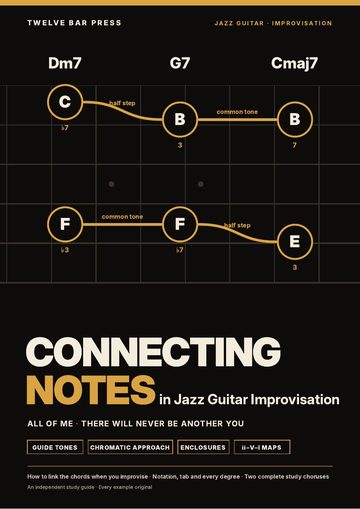
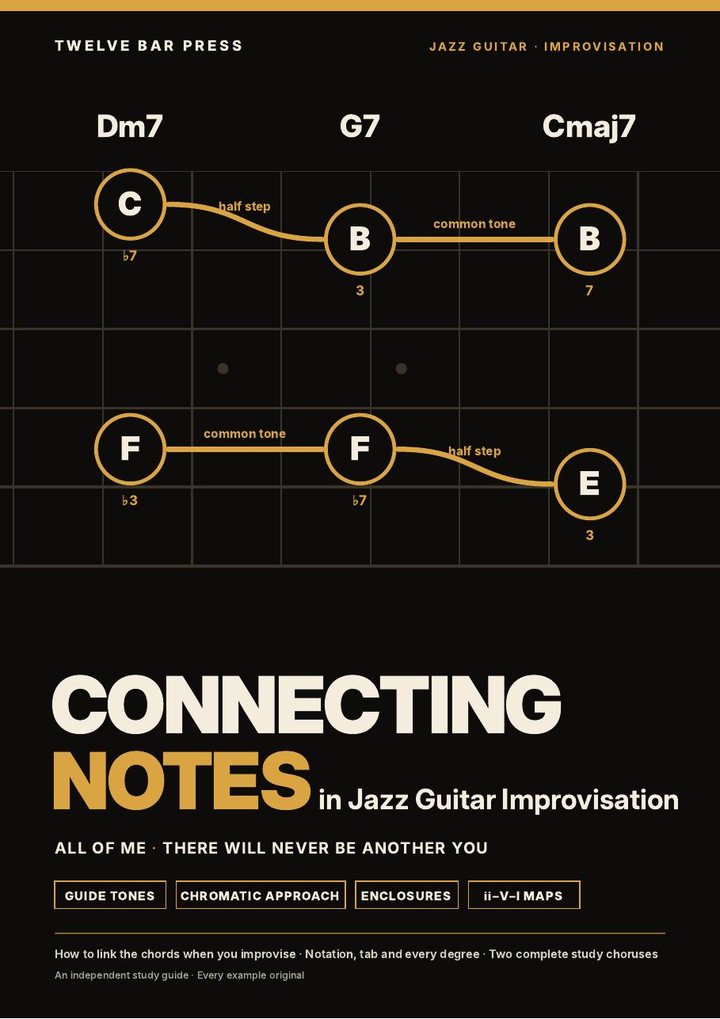
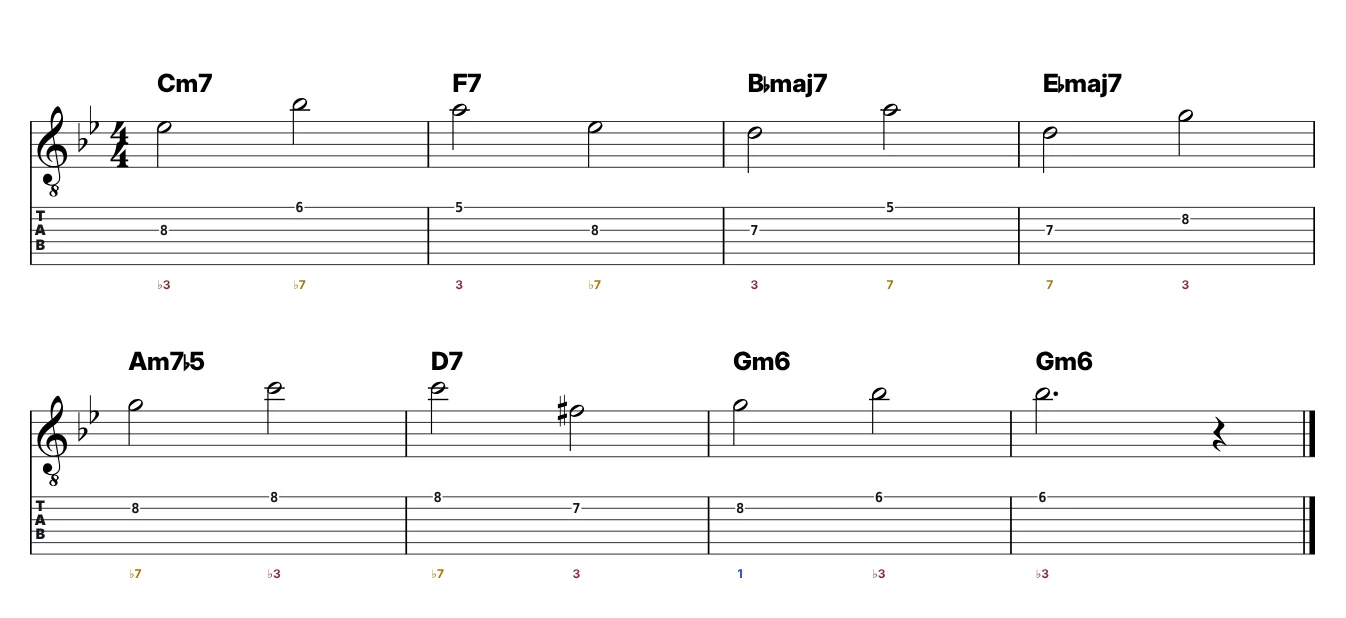
Play the 3rd and 7th of every chord through the form, choosing the closest note each time. This line is the skeleton of the harmony and a set of perfect targets for your solo. Learn more in how to improvise over chord changes.
Step 8: Choose scales and arpeggios by key area
Pick one scale per key area and the arpeggio of each chord. Over a major ii–V–I, the major scale of the key; over a minor ii–V–i, the harmonic minor of the key; over a secondary dominant, the Mixolydian or the altered scale of that chord. See what scales to use for jazz guitar.
Step 9: Practice the first section slowly
Analysis only pays off when you play it. Take the first eight bars, set the metronome to 60, and play roots, guide tones, arpeggios and finally short phrases, as in learning to improvise. Then add the next section.
Three standards analyzed step by step
- Autumn Leaves chords: analysis for jazz guitar — a major and a minor ii–V–I side by side.
- All of Me chords: analysis for jazz guitar — secondary dominants and the cycle of fifths.
- There Will Never Be Another You chords: analysis — ii–V’s to many places and the backdoor progression.
Frequently asked questions
What is a lead sheet?
A lead sheet is a page with the melody of a song and the chord symbols written above it. Jazz musicians learn and play standards from lead sheets collected in songbooks and jazz improvisation books.
Why use Roman numerals in jazz analysis?
Roman numerals describe the function of each chord in the key, so the same progression is recognizable in any key. A ii–V–I is a ii–V–I whether it is Dm7–G7–C or Fm7–B♭7–E♭.
What is a secondary dominant?
A dominant 7 chord that resolves to a chord other than the tonic — for example A7 resolving to Dm7 in the key of C (V7 of ii).
What is the backdoor progression?
A ii–V a whole step below the tonic that resolves to I — in C, Fm7–B♭7–C. It comes from the minor key and gives a soft, bluesy resolution.