Jazz Standards Analyzed
There Will Never Be Another You Chords: A Jazz Analysis for Guitar Improvisation
There Will Never Be Another You (Harry Warren and Mack Gordon, 1942) is a 32-bar jazz standard in E♭ major with an ABAC form. Its chords are a series of ii–V’s that lead to different targets — to C minor (vi), to A♭ (IV), through the backdoor progression (A♭m7–D♭7) back to E♭, and to G minor (iii) — so it trains a jazz guitarist to aim at a new target every two bars.
- Music and lyrics
- Harry Warren (music), Mack Gordon (lyrics)
- Year
- 1942, for the film Iceland
- Usual key
- E♭ major
- Form
- ABAC, four sections of eight bars
- Tempo
- medium to bright swing
Jazz musicians adopted the song in the 1950s. Chet Baker sang it on Chet Baker Sings (1954), and guitarists such as Tal Farlow, Jimmy Raney, Wes Montgomery, Joe Pass and Kenny Burrell recorded it. We only discuss the chords; learn the melody from a recording, ideally a sung version first.
The There Will Never Be Another You chord progression
E♭ major (home key) minor ii–V–i (to C minor, to G minor) ii–V–I to A♭ (IV) backdoor ii–V
Lead sheets differ in the last bars: some compress Gm7–C7 into a single bar, some add a final bar of E♭, and many players use Fm7–B♭7 in bar 12 as a turnaround.
What key is There Will Never Be Another You in?
Three flats, a first chord of E♭maj7 and a final cadence Fm7–B♭7–E♭: the song is in E♭ major. It visits C minor (the relative minor), A♭ major (the IV), G minor (the iii) and borrows the backdoor progression from E♭ minor.
A section (bars 1–8): to C minor, then to A♭
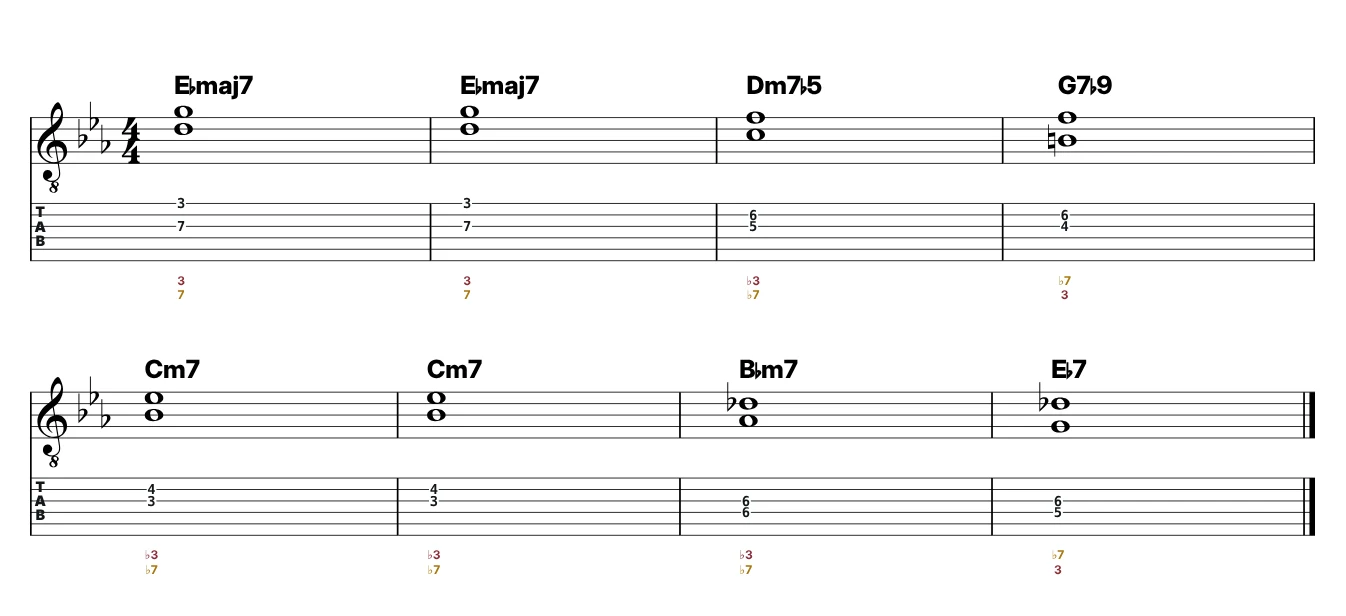
Two bars of E♭maj7, then a minor ii–V, Dm7♭5–G7♭9, which leads to Cm7, the relative minor. From Cm7 the harmony drops a whole step to B♭m7–E♭7: a ii–V in A♭, the fourth degree of the key.
B section (bars 9–16): the backdoor and the dominant of the dominant
A♭maj7 arrives, then becomes A♭m7 and D♭7. A♭m7–D♭7 is the famous backdoor ii–V: instead of reaching E♭ from its dominant B♭7, it reaches it from D♭7, a whole step below the tonic. E♭maj7 and Cm7 follow, then F7 (II7, the dominant of the dominant) for two bars, which becomes Fm7–B♭7, the ii–V of the home key.
A section again (bars 17–24)
As the first A. Repeat or develop the ideas you played in bars 1–8.
C section (bars 25–32): a new target and the way home
A♭maj7 and the backdoor again lead to E♭maj7. Then a new minor ii–V, Am7♭5–D7, leads to Gm7, the iii chord. From there the harmony walks home along the cycle of fifths: Gm7 – C7 – Fm7 – B♭7 – E♭.
The ii–V–I’s of There Will Never Be Another You
| Bars | Chords | Function | Key connection |
|---|---|---|---|
| 3–5 | Dm7♭5 → G7♭9 → Cm7 | minor ii–V–i to vi | C → B; F → E♭; A♭ (♭9) → G |
| 7–9 | B♭m7 → E♭7 → A♭maj7 | ii–V–I to IV | A♭ → G; D♭ → C |
| 10–11 | A♭m7 → D♭7 → E♭maj7 | backdoor ii–V | G♭ → F; C♭ → B♭ |
| 14–17 | F7 → Fm7 → B♭7 → E♭ | II7, then ii–V–I | A → A♭; E♭ → D; A♭ → G |
| 28–29 | Am7♭5 → D7 → Gm7 | minor ii–V–i to iii | G → F♯; C → B♭ |
| 29–32 | Gm7 → C7 → Fm7 → B♭7 → E♭ | iii–VI–ii–V–I | F → E; B♭ → A♭; E♭ → D |
Scales for There Will Never Be Another You
- Over E♭maj7, Cm7, Fm7, B♭7 and Gm7: the E♭ major scale.
- Over Dm7♭5–G7♭9 (to Cm): C harmonic minor (C D E♭ F G A♭ B).
- Over B♭m7–E♭7: A♭ major (B♭ Dorian, E♭ Mixolydian).
- Over A♭m7–D♭7: D♭ Mixolydian or A♭ Dorian.
- Over F7: F Mixolydian, with A natural.
- Over Am7♭5–D7: G harmonic minor.
How to practice There Will Never Be Another You
- Learn the melody from a sung version.
- Bars 1–8 only, at 60 bpm: roots, guide tones (Example above), arpeggios.
- Improvise over bars 3–5 aiming at E♭ (the 3rd of Cm7) on beat one of bar 5.
- Add the B section and practice the backdoor (bars 10–11) separately.
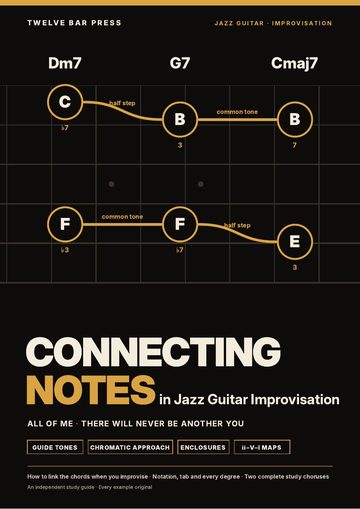
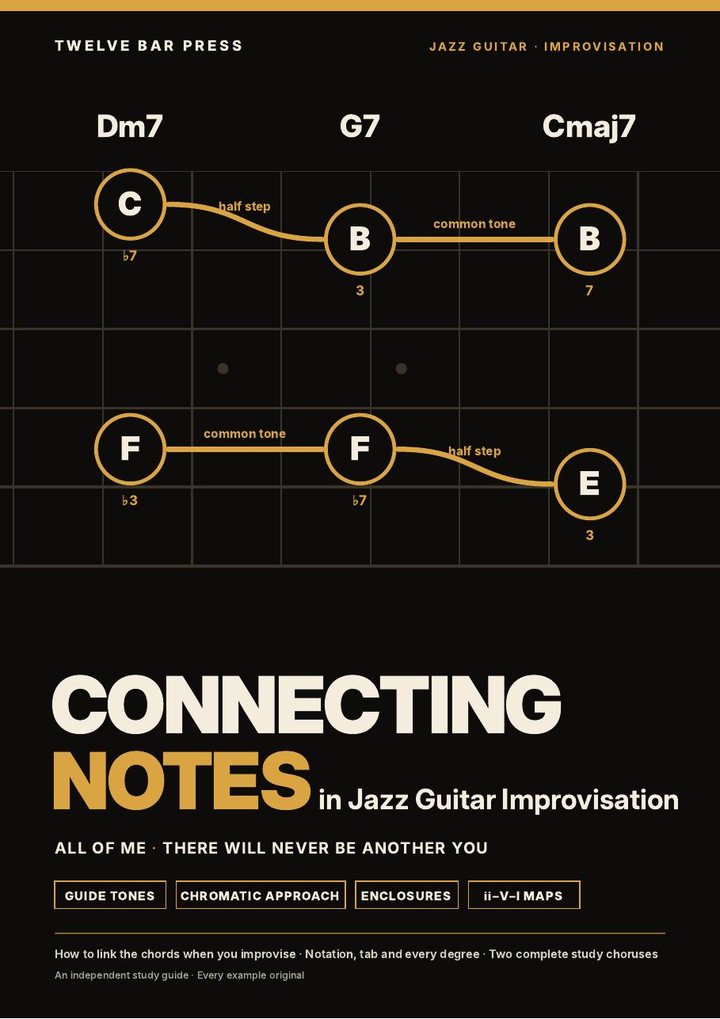
- Then the whole form. Our book Connecting Notes in Jazz Guitar Improvisation maps this tune bar by bar and includes a complete chorus.
Frequently asked questions
What are the chords to There Will Never Be Another You?
In E♭: E♭maj7 (2 bars) – Dm7♭5 – G7♭9 – Cm7 (2) – B♭m7 – E♭7 | A♭maj7 – A♭m7 D♭7 – E♭maj7 – Cm7 – F7 (2) – Fm7 – B♭7, then the first eight bars again, then A♭maj7 – A♭m7 D♭7 – E♭maj7 – Am7♭5 D7 – Gm7 – C7 – Fm7 – B♭7.
What is the backdoor progression in There Will Never Be Another You?
In bars 10 and 26, A♭m7–D♭7 resolves to E♭maj7. It is a ii–V a whole step below the tonic, borrowed from E♭ minor, used instead of the regular Fm7–B♭7.
What key is There Will Never Be Another You in?
It is usually played in E♭ major.
Who wrote There Will Never Be Another You?
Harry Warren wrote the music and Mack Gordon the lyrics, for the 1942 film Iceland.