Jazz Standards Analyzed
How to Tell What Key a Jazz Song Is In: A Guide for Guitarists
To find the key of a jazz song, check five clues: the key signature, the last chord (usually the tonic), the first chord, the dominant 7 chords and where they resolve (V7 to I), and the melody’s final note. When the key signature fits both a major key and its relative minor — B♭ major and G minor share two flats — the final chord and the resolutions decide. Jazz standards also visit other keys for a few bars, so you map those too.
Why the key matters for improvisation
The key is the home of a song: the note and the chord that everything else is heading toward. When you know the key, the chords stop being a list of symbols and become functions — I, ii, V — and you can use everything you know about those functions. A ii–V–I lick works in any key; you just need to know which key you are in.
Clue 1: the key signature
On a lead sheet, the sharps or flats at the start of each line are the key signature. Each signature fits one major key and one minor key, its relative minor (a minor 3rd below).
| Key signature | Major key | Relative minor |
|---|---|---|
| no sharps or flats | C major | A minor |
| 1 flat | F major | D minor |
| 2 flats | B♭ major | G minor |
| 3 flats | E♭ major | C minor |
| 4 flats | A♭ major | F minor |
| 1 sharp | G major | E minor |
| 2 sharps | D major | B minor |
Jazz standards are most often in flat keys — F, B♭, E♭ and their relative minors — because they suit the horns. Guitarists should get used to them early.
Clue 2: the last chord
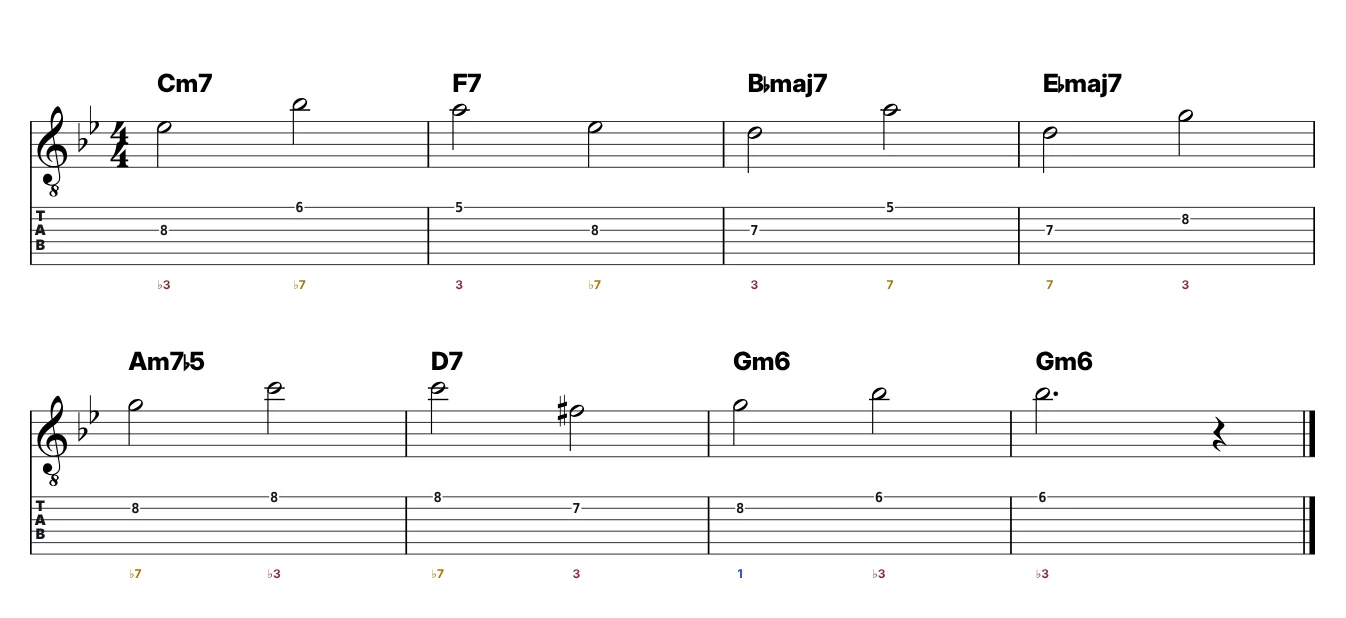
The last chord of a song is almost always the tonic, the I chord. If a lead sheet with two flats ends on Gm6, the song is in G minor, not B♭ major. This is the single most reliable clue.
Clue 3: the first chord (with care)
Many songs start on the tonic — “All of Me” starts on C and is in C. But many standards start somewhere else: “Autumn Leaves” starts on Cm7, the ii chord of B♭, even though the song is in G minor. Use the first chord as a hint, never as proof.
Clue 4: the dominant chords and where they resolve
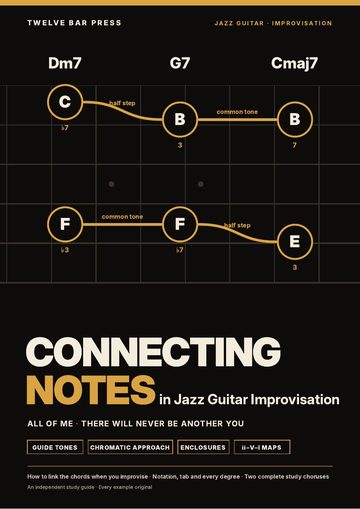
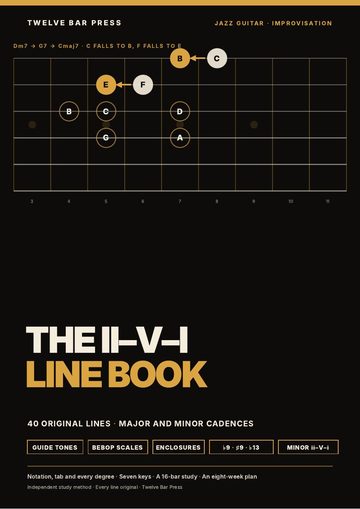
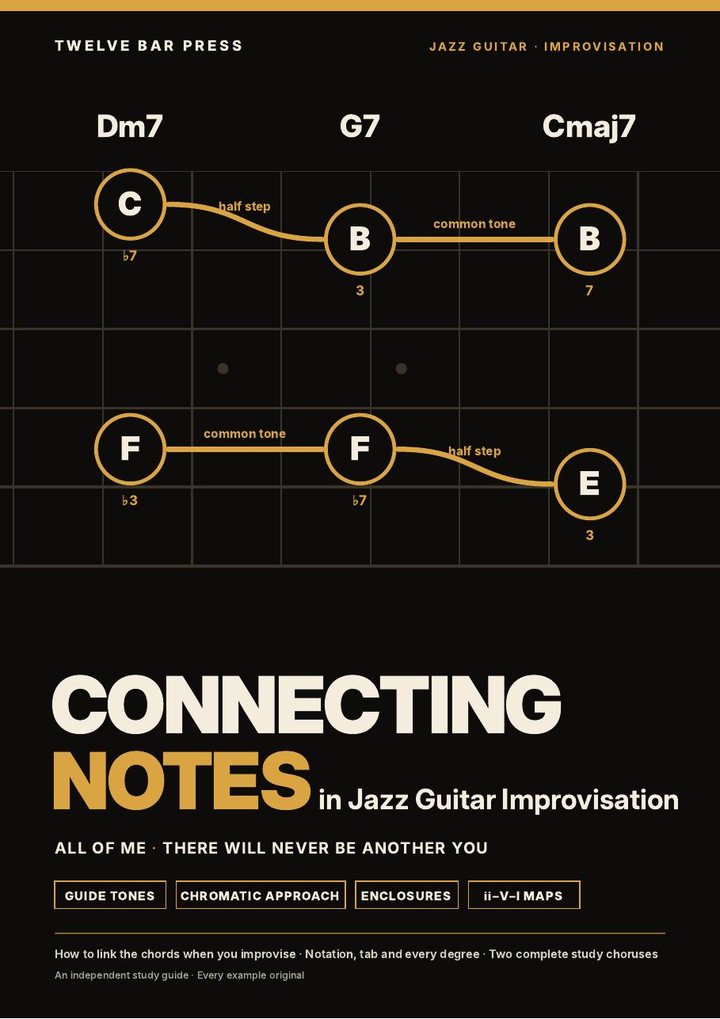
A dominant 7 chord wants to resolve down a fifth: G7 to C, D7 to G, B♭7 to E♭. When you see a V7–I (or a ii–V–I) that lands on a chord that feels like home, you have found a key. If the song keeps resolving to the same chord, that is the tonic. If a resolution appears only once, it is probably a temporary key — a tonicization.
Clue 5: the melody
The last note of the melody is usually the tonic or another note of the tonic chord. If you know the melody, sing it and stop on the last note: you will hear home.
Major or relative minor?
Because a major key and its relative minor share the same notes, the signature cannot decide between them. Look at the chords: a minor key has a minor ii–V–i (half-diminished ii, dominant V with a ♭9, minor i) and usually ends on the minor chord. “Autumn Leaves” uses both: a major ii–V–I in B♭ and a minor ii–V–i in G minor, and it ends in G minor.
Songs visit other keys: mapping the key areas
Jazz standards rarely stay in one key. A ii–V–I in another key for two or four bars is normal — the B section of an AABA tune often moves to a new key. When you analyze a song, write the key above each group of bars. This key-area map is what you improvise from: you think in a few keys instead of many chords.
| Standard | Signature | Home key | Other key areas |
|---|---|---|---|
| Autumn Leaves | 2 flats | G minor | B♭ major (relative major), passing ii–V’s |
| All of Me | none | C major | secondary dominants to A minor and D minor |
| There Will Never Be Another You | 3 flats | E♭ major | C minor, A♭ major, the backdoor, G minor |
Finding the key by ear
- Listen to the end of the recording and hum the note that feels like home.
- Find that note on the guitar.
- Play the major and the minor chord on that note along with the record: one will fit.
- Check the bass: on the final chord, the bass usually plays the tonic.
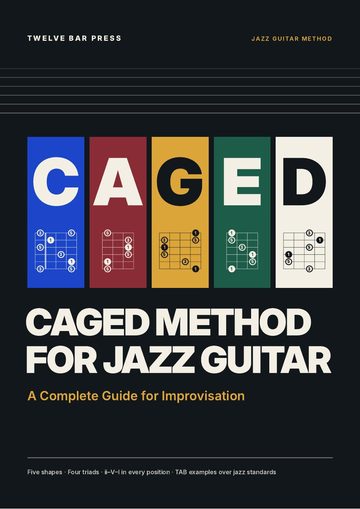
Next step: how to analyze a jazz standard for improvisation. If you need to see the keys on the fretboard, the CAGED System for Jazz Guitar maps every key in five positions.
Frequently asked questions
How do you tell what key a song is in?
Look at the key signature, then the last chord, which is usually the tonic. Confirm it by finding V7–I resolutions to that chord and by checking the last note of the melody.
Is the first chord the key of the song?
Not always. Many jazz standards start on a ii chord or another chord. “Autumn Leaves” starts on Cm7 but is in G minor. The last chord is a more reliable clue.
How do I know if a song is in major or minor?
Major and relative minor share a key signature. Look at the final chord and at the cadences: a minor ii–V–i (m7♭5 – 7♭9 – m) and a minor final chord point to the minor key.
Can a jazz standard be in more than one key?
Yes. Most standards move through two or more key areas for a few bars at a time. The home key is the one the song returns to and ends in.