Jazz Standards Analyzed
Autumn Leaves Chords: A Complete Analysis for Jazz Guitar Improvisation
Autumn Leaves (Joseph Kosma, 1945) is a 32-bar jazz standard, usually played in G minor in an AAB form. Its chords are built from two ii–V–I progressions: Cm7–F7–B♭maj7 in B♭ major, followed by E♭maj7, and Am7♭5–D7–Gm in G minor. Because the two keys share the same notes, Autumn Leaves is one of the best first standards for learning to improvise on jazz guitar.
- Composer
- Joseph Kosma (French title “Les Feuilles mortes”)
- Year
- 1945
- Usual key
- G minor (also often in E minor)
- Form
- AAB (8 + 8 + 16 bars), sometimes written AABC
- Tempo
- ballad to medium swing
In this analysis we only discuss the chords. The melody and lyrics are protected by copyright; learn the melody from a recording — singers such as Nat King Cole and Frank Sinatra recorded it, and Cannonball Adderley’s version with Miles Davis on Somethin’ Else (1958) is a classic instrumental reference.
The Autumn Leaves chord progression
B♭ major (relative major) G minor (home key) passing ii–V’s
Lead sheets differ slightly in the last eight bars. Some use G♭7 and E7 (tritone substitutes) instead of C7 and B♭7 in bars 27–28, and some write only D7 in bar 30. The logic of the analysis below is the same in every version.
What key is Autumn Leaves in?
The key signature has two flats, which fits both B♭ major and G minor. The song starts on Cm7, the ii chord of B♭ — but it ends on G minor, and its strongest cadences resolve to Gm. So Autumn Leaves is in G minor, and spends half of its time in the relative major, B♭ major.
Bars 1–4: a major ii–V–I in B♭ (and the IV chord)
Cm7–F7–B♭maj7 is a textbook ii–V–I in B♭ major. E♭maj7, the IV chord, continues the movement down by fifths: C, F, B♭, E♭. Over these four bars you can think of one scale, B♭ major, and four arpeggios.
Bars 5–8: a minor ii–V–i in G minor
Am7♭5–D7–Gm is a minor ii–V–i. The half-diminished ii chord and the dominant with its F♯ (the leading tone of G minor) tell your ear that the music has moved to the minor key. Over D7, use the G harmonic minor scale or the altered scale; the ♭9 (E♭) is the characteristic color.
Bars 17–24: the second part starts in minor
The B section reverses the order: first the minor ii–V–i to G minor, then the major ii–V–I to B♭ and the IV chord. Same material, opposite order — once you know the A section, you already know these bars.
Bars 25–32: passing ii–V’s and the ending
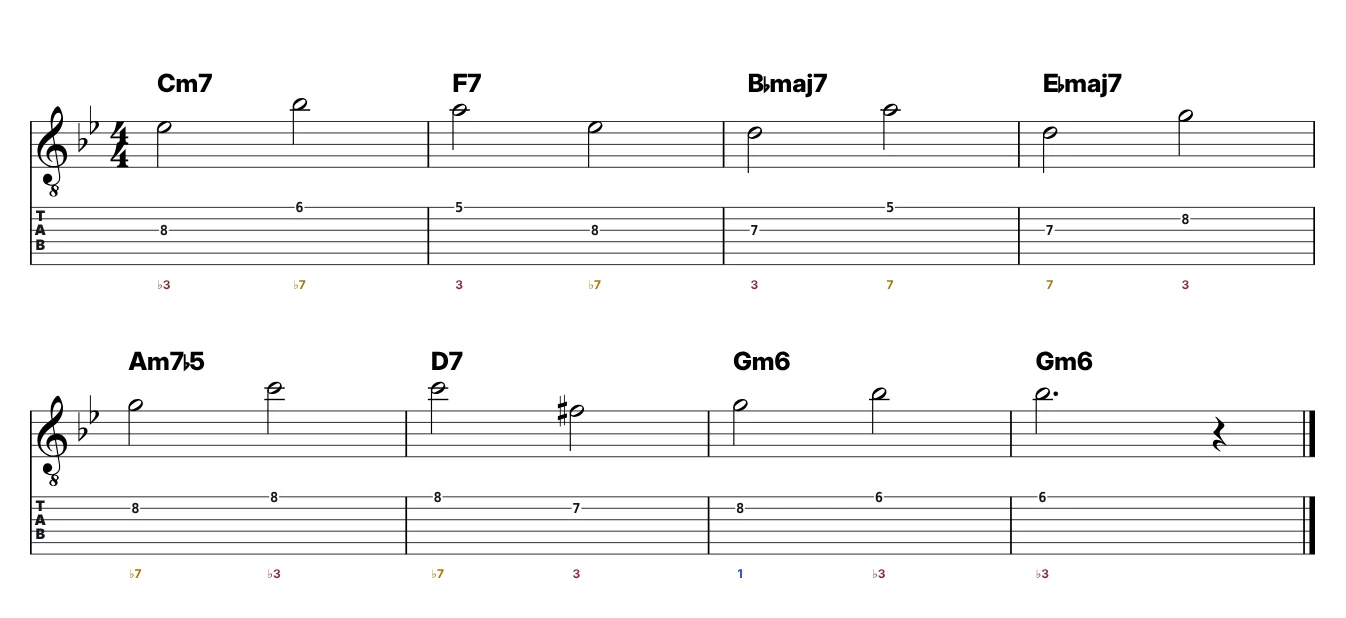
After Am7♭5–D7, the harmony slides down by whole steps through two quick ii–V’s: Gm7–C7 and Fm7–B♭7, which lands on E♭maj7, the ♭VI chord of G minor. A final ii–V (Am7♭5–D7) brings the song home to G minor. Over the passing ii–V’s, simple guide tones work best: the 3rd and 7th of each chord move by half steps.
The guide-tone map
Scales for Autumn Leaves, by key area
| Bars | Chords | Scale | Notes to aim for |
|---|---|---|---|
| 1–4, 9–12, 21–24 | Cm7 F7 B♭maj7 E♭maj7 | B♭ major | 3rds and 7ths: E♭–B♭, A–E♭, D–A, G–D |
| 5–8, 17–20 | Am7♭5 D7 Gm6 | G harmonic minor | C and G on Am7♭5; F♯ and C (plus the ♭9, E♭) on D7; B♭ and E on Gm6 |
| 27–28 | Gm7 C7 Fm7 B♭7 | guide tones only | B♭–F, E–B♭, A♭–E♭, D–A♭ |
| 29–32 | E♭maj7 Am7♭5 D7 Gm6 | E♭ major → G harmonic minor | G and D on E♭maj7, then as in bars 5–8 |
An eight-bar solo example
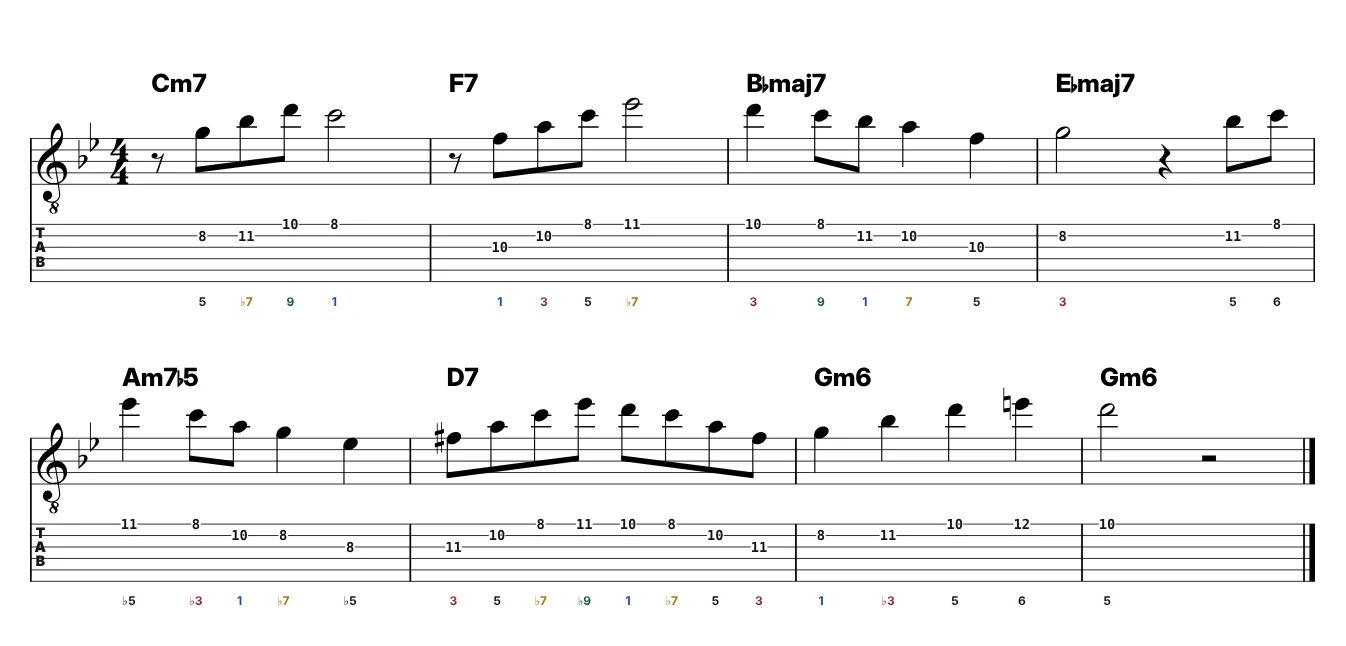
The full step-by-step construction of this solo is in how to improvise a jazz guitar solo on a standard.
How to practice Autumn Leaves
- Learn the melody from a recording and sing it.
- Bars 1–8 only: roots in half notes at 60 bpm, then guide tones, then arpeggios.
- Improvise two-bar phrases over bars 1–4 (B♭ major), then over bars 5–8 (G minor).
- Add bars 9–16 (the same as 1–8), then the B section, then bars 25–32.
- Play one complete chorus, record it and listen back the next day.
Frequently asked questions
What are the chords to Autumn Leaves?
In G minor, the A section is Cm7 – F7 – B♭maj7 – E♭maj7 – Am7♭5 – D7 – Gm6 – Gm6. The B section starts with Am7♭5 – D7 – Gm and continues with the same major ii–V–I, then ends with passing ii–V’s (Gm7–C7, Fm7–B♭7) to E♭maj7 and a final Am7♭5–D7–Gm.
What key is Autumn Leaves in?
It is most often played in G minor (two flats), and also often in E minor. Half of the song is in the relative major, B♭ major.
Is Autumn Leaves good for beginners?
Yes. It uses only two ii–V–I progressions — one major, one minor — that share the same notes, so it is one of the best first standards for learning to improvise.
What scale do you use over Autumn Leaves?
The B♭ major scale over the major ii–V–I and the G harmonic minor scale over the minor ii–V–i, always aiming at the 3rds and 7ths of the chords.