Jazz Guitarists
Herb Ellis: Biography of the Texas Swing Guitarist of the Oscar Peterson Trio
Herb Ellis (1921–2010) was an American jazz guitarist from Texas, best known as a member of the Oscar Peterson Trio with bassist Ray Brown from 1953 to 1958. He also accompanied Ella Fitzgerald, worked as a Hollywood studio musician and co-founded the group Great Guitars. His style combined Texas blues phrasing with hard-swinging bebop lines built on chord shapes.
- Born
- August 4, 1921, Farmersville, Texas
- Died
- March 28, 2010, Los Angeles
- Full name
- Mitchell Herbert Ellis
- Known for
- Oscar Peterson Trio (1953–1958); Great Guitars
- Style
- Blues-based swing and bebop, built on chord shapes
Early life and the big bands
Mitchell Herbert Ellis was born on August 4, 1921, in Farmersville, Texas. He studied music at North Texas State University, where he played bass because the school had no guitar program, and left before finishing to go on the road. He played in the Casa Loma Orchestra of Glen Gray (1943–1945) and in Jimmy Dorsey’s band until 1947.
With two Dorsey bandmates, John Frigo and Lou Carter, he formed the Soft Winds, a trio modeled on the Nat King Cole Trio. Together they wrote the standard “Detour Ahead.”
The Oscar Peterson Trio
In 1953 Ellis replaced Barney Kessel in the trio of the pianist Oscar Peterson, with Ray Brown on bass. For five years the three of them were one of the most celebrated groups in jazz, famous for their tight, driving swing. The trio was also the house rhythm section for Norman Granz’s Verve label and toured with Jazz at the Philharmonic, which put Ellis on records with many of the great soloists of the time. He left in November 1958; Peterson replaced him with a drummer rather than another guitarist.
Ella Fitzgerald, Hollywood and Great Guitars
From 1957 to 1960 Ellis toured as Ella Fitzgerald’s guitarist. He then spent years as a busy studio musician in Los Angeles, before returning to jazz full time in the 1970s. He recorded duets with Joe Pass — Seven, Come Eleven and Two for the Road (both 1974) — and an album with Freddie Green, Rhythm Willie (1975). With Charlie Byrd and Barney Kessel he formed Great Guitars. He died in Los Angeles on March 28, 2010.
The Herb Ellis sound: what defines his style
- Chord formations: he improvised from a few chord shapes he could move anywhere on the neck, rather than from scales.
- Texas blues: bends, double stops and country-flavored phrases inside bebop lines.
- Relentless swing: strong, driving eighth notes and a heavy accent on the beat.
- Rhythm guitar: three-note chords and the percussive comping he played behind Oscar Peterson.
Essential recordings
- At the Stratford Shakespearean Festival (Oscar Peterson Trio, 1956) — the trio at its peak.
- Nothing but the Blues (1957) — his blues side, front and center.
- Seven, Come Eleven (1974, with Joe Pass) — two guitars, live and swinging.
- Rhythm Willie (1975, with Freddie Green) — a lesson in rhythm guitar.
What guitarists can learn from Herb Ellis
- Learn to solo from chord shapes: pick two shapes for a blues and find the lines inside them.
- Add bends and double stops to your jazz lines for a bluesy edge.
- Practice comping with three-note chords behind a soloist.
- Play with strong time: accent the beat and make the line swing before you make it fast.
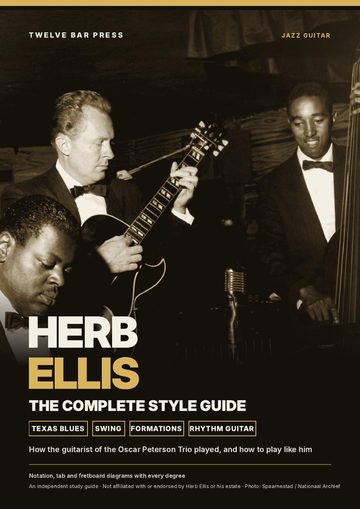
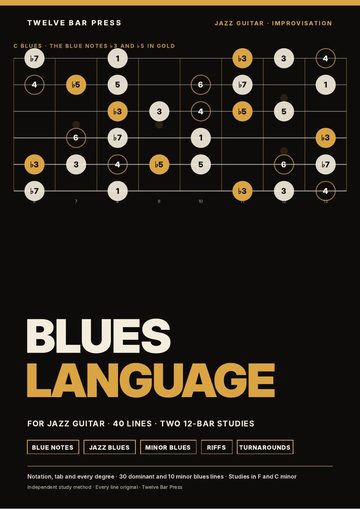
Our Herb Ellis Guitar Style Guide teaches his chord formations, his blues and his rhythm guitar, with five tune lessons. For more blues vocabulary in a jazz context, see Blues Language for Jazz Guitar.
Frequently asked questions
When was Herb Ellis in the Oscar Peterson Trio?
From 1953, when he replaced Barney Kessel, until November 1958, with Oscar Peterson on piano and Ray Brown on bass.
What was Herb Ellis’s style?
Hard-swinging jazz guitar with Texas blues phrasing, built on movable chord shapes rather than scales, plus strong rhythm guitar.
Did Herb Ellis record with Joe Pass?
Yes. Their duo albums include Seven, Come Eleven and Two for the Road, both from 1974.