Jazz Guitarists
Joe Pass: Biography of the Virtuoso of Solo Jazz Guitar
Joe Pass (1929–1994) was an American jazz guitarist famous for unaccompanied solo guitar, playing melody, bass lines and chords at the same time. After overcoming heroin addiction through the Synanon program, he recorded for Norman Granz’s Pablo label, where his solo album Virtuoso (1974) became a landmark. He also recorded with Oscar Peterson and made six albums with Ella Fitzgerald.
- Born
- January 13, 1929, New Brunswick, New Jersey
- Died
- May 23, 1994, Los Angeles
- Birth name
- Joseph Anthony Jacobi Passalacqua
- Known for
- Solo jazz guitar; the album Virtuoso (1974)
- Worked with
- Ella Fitzgerald, Oscar Peterson, Herb Ellis
Early life in Pennsylvania
Joseph Anthony Jacobi Passalacqua was born on January 13, 1929, in New Brunswick, New Jersey, and grew up in Johnstown, Pennsylvania, the son of a steelworker born in Sicily. He got his first guitar at about nine, and his father pushed him to practice hard. By fourteen he was already playing paid jobs with dance bands.
Addiction, Synanon and a second chance
After military service, Pass became addicted to heroin and spent much of the 1950s in and out of prison. He recovered during a long stay at the Synanon rehabilitation program in California. His recording career began there: Sounds of Synanon was released in 1962. Two years later he recorded For Django (1964), a tribute to Django Reinhardt.
Pablo Records and Virtuoso
In December 1973 the producer Norman Granz signed Pass to his new label, Pablo. The next year Pass released Virtuoso (1974), an album of standards played entirely on unaccompanied guitar. It showed that a single guitar could sound like a complete band, and it remains the reference for solo jazz guitar.
At Pablo he recorded The Trio (1974) with Oscar Peterson and the bassist Niels-Henning Ørsted Pedersen, which won a Grammy, and six duo albums with Ella Fitzgerald, beginning with Take Love Easy (1973). He also recorded duets with Herb Ellis. He died of liver cancer in Los Angeles on May 23, 1994.
The Joe Pass sound: one guitar, three parts
The secret of Joe Pass is that he thought like a pianist. In his solo playing you can hear three layers, often at the same time:
- A walking bass line on the low strings, keeping the time.
- Chords on the middle strings, often just the 3rd and 7th, placed between the bass notes.
- Melody and improvised lines on top, with the phrasing of a horn player.
- Chord melody on ballads: the melody harmonized with a different chord on almost every note.
- Fingerstyle and pick: he moved between fingers, hybrid picking and a pick.
Essential recordings
- Virtuoso (1974) — the landmark of solo jazz guitar.
- For Django (1964) — his tribute to Django Reinhardt.
- The Trio (1974, with Oscar Peterson) — Grammy-winning trio playing.
- Take Love Easy (1973, with Ella Fitzgerald) — the art of accompanying a singer.
- Two for the Road (1974, with Herb Ellis) — guitar duets.
What guitarists can learn from Joe Pass
- Learn walking bass lines on the guitar and play guide-tone chords over them.
- Arrange a standard in chord melody: melody on top, chords below.
- Practice switching between bass, chords and lines inside one chorus.
- Think like a pianist: every voice has a job.
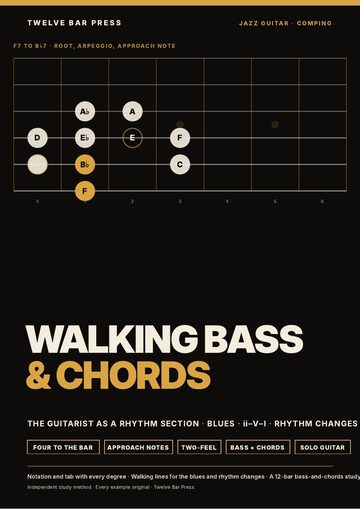
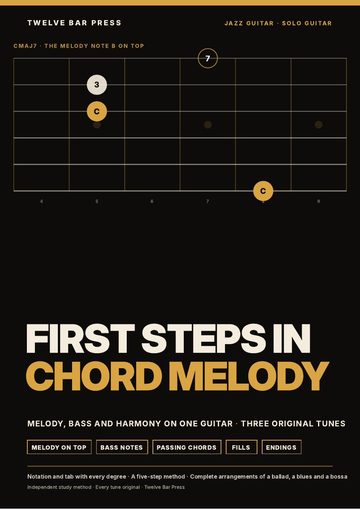
Two of our books follow his path: Walking Bass & Chords, from the first walking line to a 12-bar bass-and-chords study, and First Steps in Chord Melody, a five-step method with three complete arrangements.
Frequently asked questions
Why is Joe Pass’s Virtuoso album so famous?
Released in 1974, Virtuoso features Joe Pass alone, playing melody, bass lines and chords at once on jazz standards. It set the standard for solo jazz guitar.
Did Joe Pass play with Ella Fitzgerald?
Yes. He recorded six duo albums with her for Pablo Records, starting with Take Love Easy in 1973.
How do you play like Joe Pass?
Start with walking bass lines and add two-note chords (3rd and 7th) between the bass notes; then learn to harmonize melodies in chord melody style.