Jazz Guitarists
Django Reinhardt: Biography, the Two-Finger Technique and the Birth of Gypsy Jazz
Django Reinhardt (1910–1953) was a Belgian-born Romani jazz guitarist and composer, the first major jazz musician from Europe and the founder of gypsy jazz. After a caravan fire in 1928 badly burned the ring and little fingers of his left hand, he rebuilt his technique around two fingers. With violinist Stéphane Grappelli he led the Quintette du Hot Club de France and wrote standards such as “Minor Swing” and “Nuages.”
- Born
- January 23, 1910, Liberchies, Belgium
- Died
- May 16, 1953, Fontainebleau, France
- Real name
- Jean Reinhardt
- Known for
- Founding gypsy jazz; the Quintette du Hot Club de France
- Famous compositions
- “Minor Swing,” “Nuages,” “Djangology,” “Daphne”
Early life in the Romani camps
Jean “Django” Reinhardt was born on January 23, 1910, in Liberchies, Belgium, into a family of Manouche Romani descent. He grew up mostly in Romani encampments on the outskirts of Paris, playing the banjo-guitar, the violin and the guitar from childhood, and was working as a musician in Paris dance halls while still a teenager.
The fire and the two-finger technique
On November 2, 1928, a candle set fire to the celluloid flowers in his caravan. Django was burned over about half of his body. Doctors wanted to amputate his right leg, which he refused, and the ring and little fingers of his left hand were so badly damaged that they doubted he would ever play guitar again.
During his long recovery he retaught himself. He played most single-note lines with only his index and middle fingers, using the injured fingers for some chords, and developed a chord system based largely on compact three-note voicings. This limitation shaped his sound: fast arpeggios played across the strings, chromatic runs up one string, and small, punchy chords. Guitarists still study “Django’s hand” today.
The Quintette du Hot Club de France
In 1934, with the violinist Stéphane Grappelli, Django formed the Quintette du Hot Club de France, an all-string band: lead guitar, violin, two rhythm guitars and double bass. The rhythm guitars played la pompe, a pumping, percussive accompaniment that replaced the drums. The group recorded “Minor Swing” in 1937 and became the most famous jazz band in Europe.
When World War II began in 1939, the Quintet was touring Britain. Grappelli stayed in London; Django returned to Paris and kept working in occupied France, despite the danger for a Romani musician. His composition “Nuages” (1940) became an unofficial song of hope in wartime Paris.
After the war: Duke Ellington and the electric guitar
In the autumn of 1946 Django toured the United States as a guest soloist with Duke Ellington’s orchestra. Back in Europe he absorbed bebop, fitted a pickup to his guitar and later played electric guitar in Paris clubs, with longer lines and more modern harmony. He retired to Samois-sur-Seine, near Fontainebleau, where he died of a brain hemorrhage on May 16, 1953, at 43. Samois still hosts a festival in his honor.
The Django Reinhardt sound: what defines gypsy jazz guitar
- Arpeggios of 6 and 6/9 chords, minor 6 chords and diminished chords, swept across the strings.
- Chromatic runs up and down one string, often in triplets.
- Rest-stroke picking: the pick comes to rest on the next string, which gives a loud, round tone.
- La pompe rhythm guitar: bass-like downstrokes on beats one and three, short chords on two and four.
- Drama: tremolo, octaves, sudden silences and bluesy bends.
Essential recordings
- “Minor Swing” (1937) — the gypsy jazz anthem every student learns first.
- “Nuages” (1940) — his most famous ballad.
- “Djangology” — recorded several times, a showcase of his arpeggios.
- Recordings with Stéphane Grappelli (1934–1939) — the classic Quintette sound.
- Late electric recordings (early 1950s) — Django’s bebop period.
What guitarists can learn from Django
- Learn la pompe first: rhythm is the foundation of gypsy jazz.
- Practice arpeggios of 6, m6 and dim7 chords in one position until you can sweep them.
- Learn one solo chorus on Minor Swing and analyze where the chord tones fall.
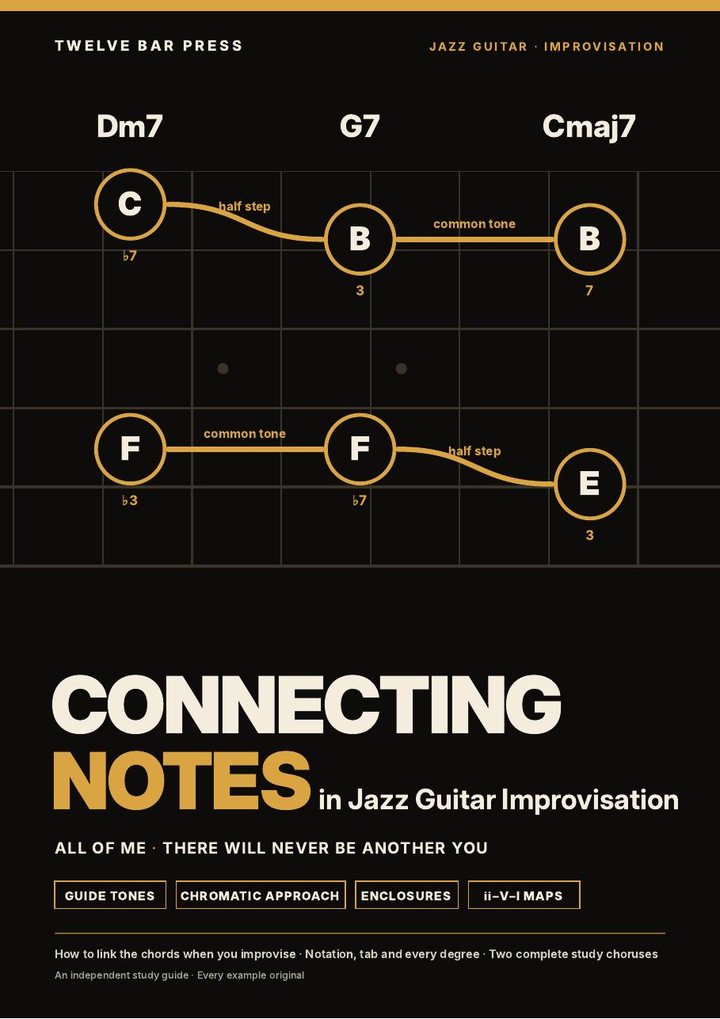
- Use chromatic approach notes and enclosures to connect arpeggios, as Django did.
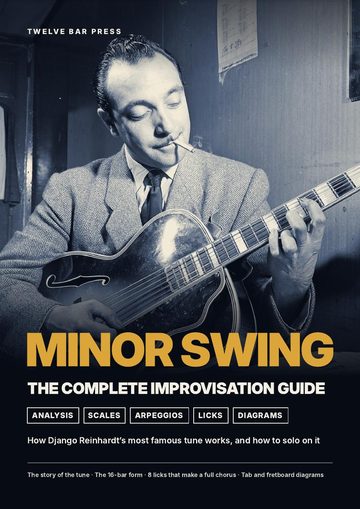
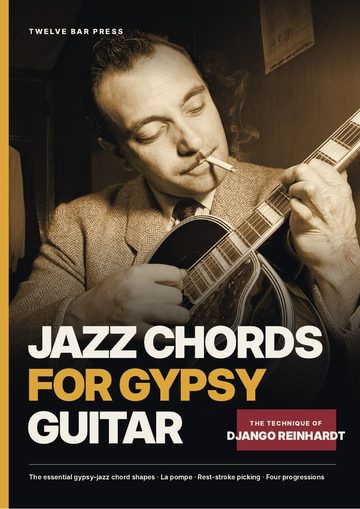
Start with Minor Swing: The Complete Improvisation Guide and Jazz Chords for Gypsy Guitar, which teaches la pompe and Django’s small chord shapes. Then meet his contemporary Oscar Alemán.
Frequently asked questions
What happened to Django Reinhardt’s fingers?
In November 1928 a fire in his caravan badly burned the ring and little fingers of his left hand. He relearned the guitar playing most lines with his index and middle fingers and using the injured fingers only for some chords.
When did Django Reinhardt record Minor Swing?
Django Reinhardt and Stéphane Grappelli recorded “Minor Swing” with the Quintette du Hot Club de France in 1937.
What is gypsy jazz?
Gypsy jazz (jazz manouche) is the style created by Django Reinhardt in 1930s France: swing played by acoustic guitars, violin and bass, with la pompe rhythm guitar instead of drums.