Jazz Guitarists
Freddie Green: Biography and Rhythm Guitar Style of Count Basie’s Guitarist
Freddie Green (1911–1987) was an American jazz guitarist who played rhythm guitar in the Count Basie Orchestra for about fifty years, from 1937 until his death. With Basie, bassist Walter Page and drummer Jo Jones he formed the “All-American Rhythm Section.” He rarely soloed; his steady four-to-the-bar chords became the model of big-band rhythm guitar.
- Born
- March 31, 1911, Charleston, South Carolina
- Died
- March 1, 1987, Las Vegas, Nevada
- Band
- Count Basie Orchestra, 1937–1987
- Known for
- Four-to-the-bar rhythm guitar; the All-American Rhythm Section
- Composition
- “Corner Pocket” (recorded by Basie in 1955)
Early life and the call from Count Basie
Frederick William Green was born on March 31, 1911, in Charleston, South Carolina. He started on the banjo and switched to the guitar in his early teens. In New York, the talent scout John Hammond heard him play in a club and introduced him to Count Basie. In 1937 Basie came to hear Green and hired him on the spot.
Fifty years in the Basie band
Green stayed with Basie for about fifty years, with only one short interruption — one of the longest tenures in jazz history. With Basie on piano, Walter Page on bass and Jo Jones on drums, he was part of the famous All-American Rhythm Section, the light, swinging engine of the Basie sound. He died in Las Vegas on March 1, 1987.
He almost never soloed. A rare exception was a jam session on “Honeysuckle Rose” at Benny Goodman’s Carnegie Hall concert of January 16, 1938. He did record under his own name — Mr. Rhythm (1955) and Rhythm Willie (1975), with Herb Ellis — and he wrote “Corner Pocket,” a Basie favorite.
The Freddie Green sound: how to play four to the bar
Green’s style looks simple on paper and is very hard to play well. Here is what a teacher would point out:
- Four even quarter notes per bar, short and light, with a slight accent on beats two and four.
- Small chords: he fretted shapes on four strings but let only some notes sound, often just the 3rd and 7th over a bass note, muting the rest with his left hand.
- Frequent chord changes, sometimes a new chord on every beat, so the inner voices move like a small melody.
- An acoustic archtop guitar, unamplified, blending with the bass and the hi-hat rather than sitting on top.
- Time above everything: the job is to make the band swing, not to be heard.
Essential recordings
- Count Basie Orchestra, late 1930s — the All-American Rhythm Section at its peak.
- April in Paris (Count Basie, 1955) — includes Green’s “Corner Pocket.”
- Mr. Rhythm (1955) — his own album.
- Rhythm Willie (1975, with Herb Ellis) — two guitarists, all swing.
What guitarists can learn from Freddie Green
- Learn shell voicings with the root on the 6th and 5th strings for every common chord.
- Practice four to the bar with a metronome until it feels relaxed at slow and fast tempos.
- Make the inner voices move by half steps from chord to chord.
- Listen to the bass and drums while you play: blend in.
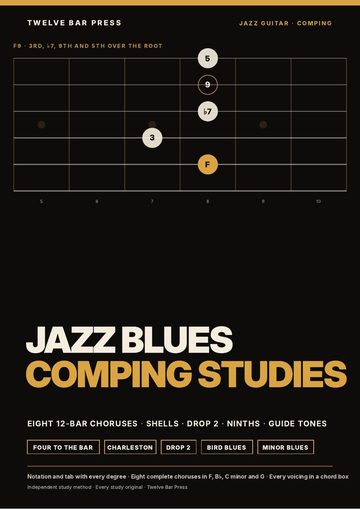
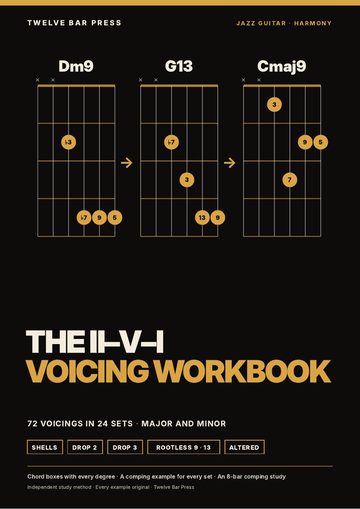
Study 1 of Jazz Blues Comping Studies is a full chorus of four-to-the-bar shells on the jazz blues, and The II–V–I Voicing Workbook gives you the shell voicings for every ii–V–I.
Frequently asked questions
How long did Freddie Green play with Count Basie?
About fifty years, from 1937 until his death in 1987, with one short interruption.
Did Freddie Green ever solo?
Very rarely. He was a rhythm guitarist by choice; a well-known exception is a jam session on “Honeysuckle Rose” at Benny Goodman’s 1938 Carnegie Hall concert.
What is Freddie Green style guitar?
Four-to-the-bar rhythm guitar with small chords — often just the 3rd and 7th over a bass note — played short, even and light on an acoustic archtop.