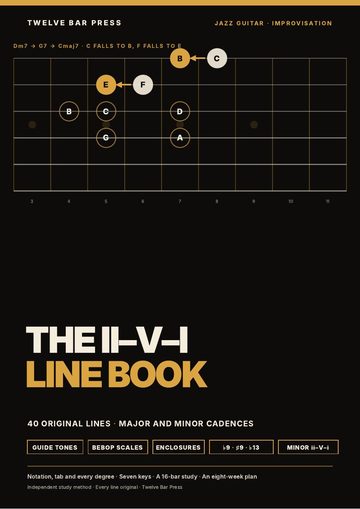
The II–V–I Line Book
$9.99
Methods & Technique
Explained without the fear: chords, functions, the ii–V–I, scales and arpeggios on the neck, comping and a six-week plan
Jazz Guitar Books. Online store · 71 pages · PDF · Updated
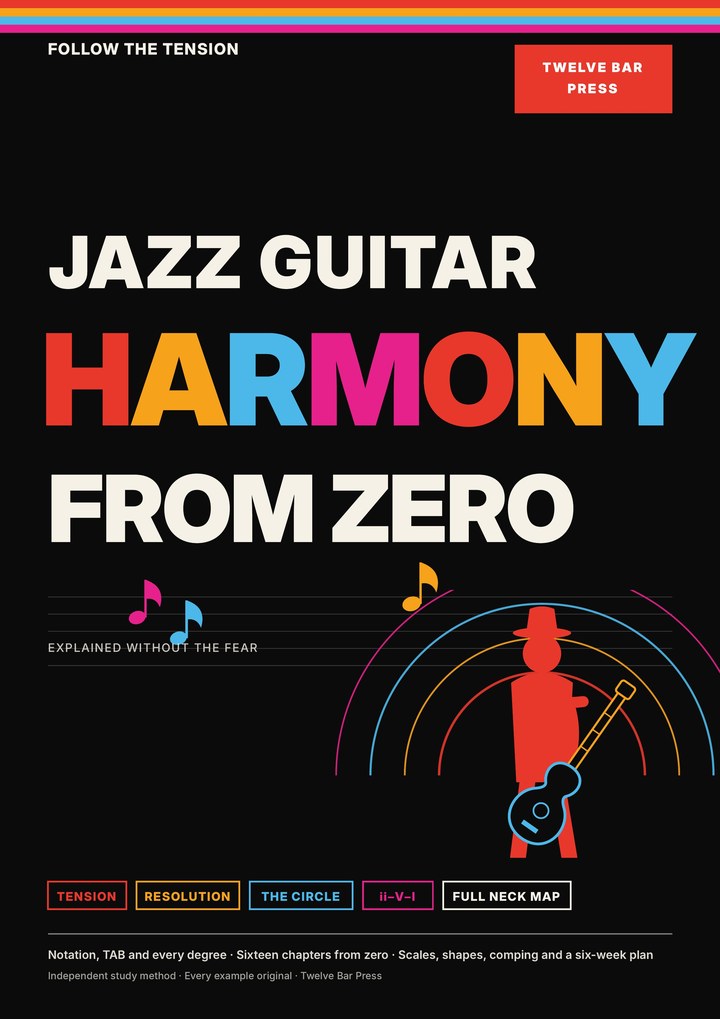
Jazz Guitar Harmony from Zero: Follow the Tension is a 71-page PDF jazz guitar method book from Jazz Guitar Books. Online store that teaches jazz chord progressions and guitar harmony from zero, from how chords are built to the ii–V–I and the circle of fifths. It includes sixteen chapters, a 16-bar practice chart, the major scale on the neck, arpeggios, drop 2 shapes, comping, daily drills, a glossary and five appendices. Every example is written in standard notation, TAB and chord degrees, for beginning to intermediate guitarists.
Jazz chord progressions can feel like a code nobody explained to you. Jazz Guitar Harmony from Zero: Follow the Tension is that explanation: an independent jazz guitar harmony method that starts from zero and builds one idea at a time.
It covers how chords are built from thirds, the three functions of tonic, subdominant and dominant, the ii–V–I in major and minor, secondary dominants, borrowed chords and voice leading. Diagrams show chord functions, the circle of fifths and the distance between degrees.
Every example is original and appears in standard notation with TAB and the degree of every note. The book is an English PDF and has no audio.
For guitarists who know a few chords and want to understand jazz harmony, not just memorize shapes. Basic to intermediate.
Each example is written in standard notation with its rhythm (guitar sounds an octave lower than written) and in TAB, with the degree of every note against the chord printed under it and colored by function. Fretboard diagrams show shapes and positions.
The PDF is licensed to the buyer for personal study. You may print it for your own use and keep it on all your devices. See the license terms.
No. Notation and TAB sit side by side, and each idea is explained in words first.
Basic to intermediate. You should know a few open chords and how to change between them.
No. It is a written method. Every example is original and meant to be played and heard.
A dictionary shows shapes. This book explains why the shapes move, so you can build your own progressions.